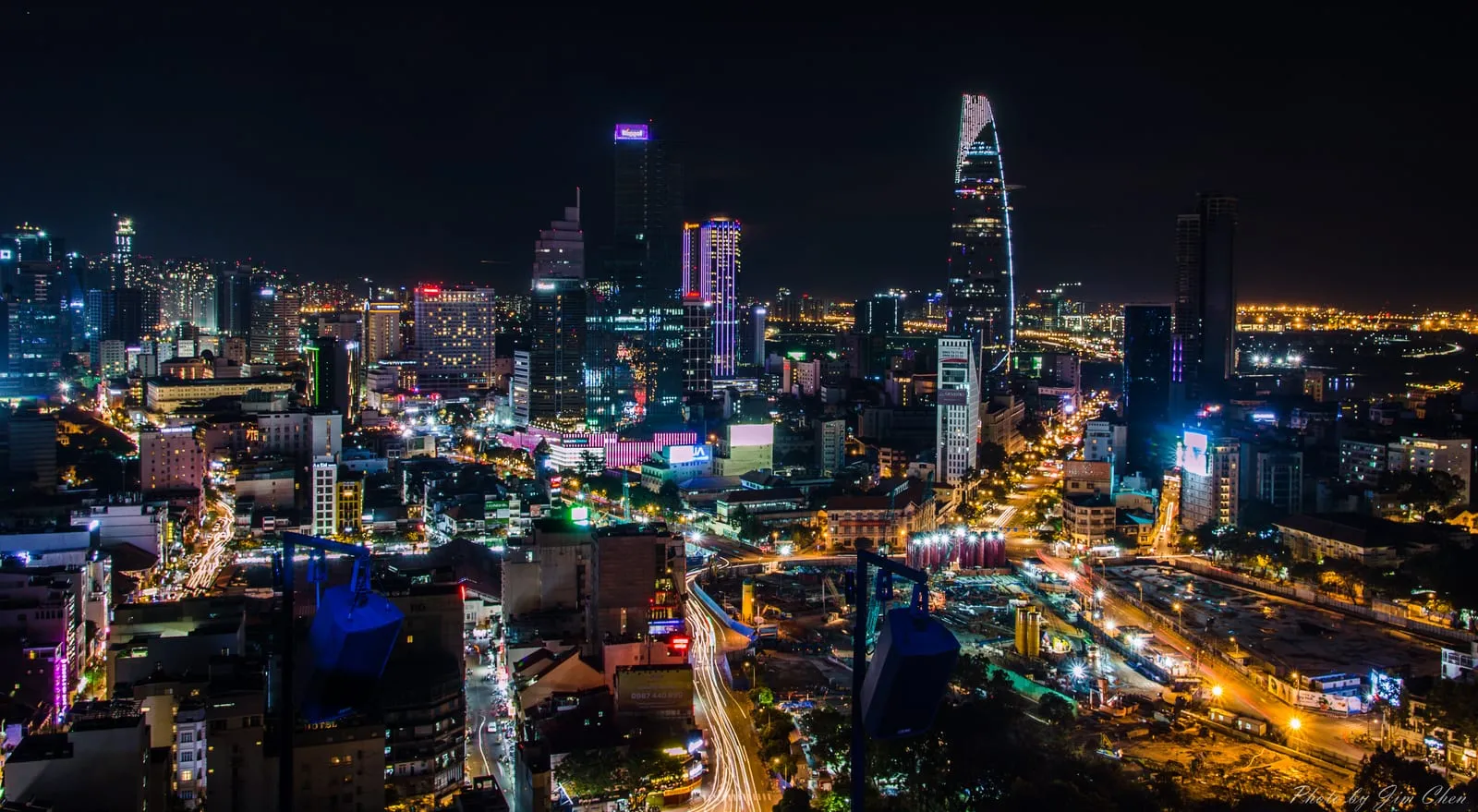
The Vietnam of the 2020s is, by most quantitative measures, a country that the country of the 1980s could not have imagined. A hundred million people, growing slowly. A median age in the early thirties. An upper-middle-income classification on the World Bank's scale, with reach toward high-income status by the 2040s on standard projections. A manufacturing economy fully integrated into East Asian supply chains, increasingly diversified into electronics and higher-value goods. A diaspora of perhaps five million people abroad, sending back remittances and increasingly returning to invest. A geopolitical position that has become unexpectedly central to the contemporary US-China contest, and that the Vietnamese leadership has handled with notable strategic agility.
It remains, simultaneously, a one-party state with limited civil liberties, an environment with serious pollution and climate vulnerability, an economy still dependent on cheap manufacturing labor, and a society whose recent transformation has produced wealth gaps and stresses that are visible everywhere in the major cities.
This essay is a snapshot of the country in the mid-2020s, written knowing that any such snapshot will date.
Demographics and society
Vietnam in 2026 has approximately 100 million people, making it the fifteenth-largest country by population. Population growth has slowed to under 1% per year. The total fertility rate is at or just below replacement (around 1.95), and demographers project that the population will plateau around 105-108 million by the 2040s before beginning a slow decline.
The country is in a demographic dividend phase — a relatively brief window in which the working-age population is large relative to both the dependent young and the elderly. This window is now closing; by the 2030s, the aging trend will accelerate, and Vietnam will need to navigate the same demographic transition that has constrained Japan, South Korea, and increasingly China. The window is being used, deliberately, to push wages and productivity up the value chain before the demographic constraint binds.
Urbanization has proceeded rapidly. Roughly 39% of the population is now urban, up from about 20% in 1990. Hanoi and Ho Chi Minh City each have about 9-10 million people in their core metropolitan areas, with secondary cities — Đà Nẵng, Hải Phòng, Cần Thơ, Biên Hòa — growing fast. Internal migration from the rural countryside to urban factories has been a major engine of the economic transformation, with associated social stresses around family separation, urban housing pressure, and rural community decline.
The middle class has grown substantially. By the McKinsey Global Institute's working definition (households with enough disposable income for non-staple consumption), Vietnam went from a near-zero middle class in 1990 to roughly 33% of the population in 2020, with continued rapid growth projected. The Vietnamese consumer market has become a target for international firms — automotive (Toyota, Hyundai, the local VinFast), retail, fast food, electronics, fashion — in ways that would have been unthinkable a generation ago.
The manufacturing economy
Vietnam's economic structure has shifted from agricultural to manufacturing-led, with services rising as a share but manufacturing remaining the engine.
Manufacturing accounts for roughly 25% of GDP. Major sectors:
- Electronics, with Samsung as the central case study. Samsung manufactures a substantial share of its global smartphone and electronics output in Vietnamese factories, employing about 100,000 workers directly and many more in supplier networks. LG, Intel, and a growing list of others have similar Vietnamese operations. The country has become, in the 2020s, the world's second-largest smartphone exporter by value.
- Garments, textiles, and footwear, the older mainstay. Vietnam is among the world's top three exporters in each, with major brands (Nike, Adidas, H&M, Uniqlo) sourcing significant shares from Vietnamese factories.
- Furniture and wood products, where Vietnamese factories supply a large fraction of the US furniture market.
- Agricultural exports — rice, coffee (the focus of essay 6), seafood, rubber, cashews, pepper. Vietnam is among the top global exporters in several of these categories.
The pivotal shift has been the China-Plus-One dynamic in the 2010s and 2020s. As Chinese wages rose, US-China trade tensions intensified, and supply-chain diversification became a priority for multinationals, Vietnam emerged as the most natural alternative manufacturing base in East Asia. The combination of relatively low wages, political stability, infrastructure investment, and proximity to Chinese supplier networks (most parts and components for Vietnamese assembly still flow from China) made the country an obvious destination for relocated manufacturing.
The structural challenge for Vietnam is that the assembly-and-export model produces lower margins than higher-value design, R&D, and capital-goods manufacturing. The country is, deliberately, trying to climb the value chain — pushing into chip assembly and (at the lower end) semiconductor manufacturing, expanding domestic R&D capacity, building local supplier networks rather than purely importing components for assembly. The transition is real but partial; most of the high-value design and engineering work for products manufactured in Vietnam still happens elsewhere.
Geopolitics
Vietnam's strategic environment in the 2020s is dominated by China.
The two countries share a long history that includes a thousand years of Chinese rule, repeated medieval invasions repulsed by Vietnamese dynasties, and the 1979 Sino-Vietnamese War. They also share a long, formal post-1991 normalization, deep economic interdependence (China is Vietnam's largest trading partner), and a Communist-Party-to-Communist-Party institutional relationship that runs continuously even when bilateral tensions rise.
The current friction is over the South China Sea (the Biển Đông, the East Sea). China claims, on the basis of the disputed Nine-Dash Line, almost the entire South China Sea, including waters and features that fall within the exclusive economic zones of Vietnam, the Philippines, Malaysia, Brunei, and Indonesia under standard interpretations of UNCLOS (the UN Convention on the Law of the Sea). China's island-building and military fortification campaigns in the Spratly and Paracel Islands since 2014 have sharply heightened the dispute. Vietnam has clashed with China repeatedly at sea, including a 2014 oil-rig confrontation that produced anti-Chinese riots in Vietnamese cities.
Vietnam's response has been a deliberate hedging strategy: deepen defense ties with the United States, India, Japan, Australia, and the Philippines without formally aligning with any of them; maintain a vocal claim to disputed features; quietly fortify Vietnamese-held positions; build up the Vietnamese coast guard and navy; and continue normal economic and political relations with China across most other dimensions.
The relationship with the United States has warmed considerably. The two countries normalized relations in 1995, established a comprehensive partnership in 2013, and upgraded to a comprehensive strategic partnership in 2023 — the highest tier in Vietnam's diplomatic taxonomy, previously reserved for China and Russia. President Biden visited Hanoi in September 2023; trade between the two countries has grown enormously, with the US now Vietnam's largest export market by far.
The Vietnamese diplomatic doctrine, sometimes called bamboo diplomacy (after a phrase used by the late General Secretary Nguyễn Phú Trọng), is to remain rooted in core national interests while bending flexibly with external winds, refusing alliance commitments while maintaining productive bilateral relationships with all major powers. The doctrine has, so far, allowed Vietnam to extract substantial benefits from both sides of the US-China contest.
The political system
Vietnam in 2026 remains a one-party state under the Communist Party of Vietnam. The institutional structure has the standard features of a Leninist party-state — Party congress every five years, Politburo, Central Committee, parallel state and party hierarchies, with the Party constitutionally supreme. The four highest political posts — General Secretary of the Party, President, Prime Minister, Chairman of the National Assembly — are held by four separate individuals (the four pillars configuration).
The 2020s have been politically turbulent at the top. An ongoing anti-corruption campaign — informally called the Blazing Furnace (lò lửa), and intensified after Nguyễn Phú Trọng's death in July 2024 — has led to the prosecution and removal from office of multiple senior figures, including two presidents (Nguyễn Xuân Phúc and Võ Văn Thưởng), a chairman of the National Assembly, and a number of provincial party secretaries. The campaign has been, by Vietnamese standards, exceptionally aggressive, and has reshaped the senior leadership in ways that are still being absorbed.
Civil liberties remain restricted. Press freedom is among the lowest in Southeast Asia by international rankings. Bloggers and activists who criticize the Party are detained and prosecuted with some regularity. Religious freedom is constrained for some groups (most visibly the Falun Gong, certain Protestant evangelical denominations, and unauthorized Buddhist organizations). Public protest is largely suppressed.
These constraints have not, in practice, prevented the economic transformation, and they remain compatible — for now — with the kind of public legitimacy the Party draws on. The Vietnamese leadership's bargain with the population has been, in essence: rapid economic improvement, national unity, foreign-policy autonomy, and a guarantee that the Party's monopoly on political power will not be challenged. That bargain has held for forty years. Whether it will continue to hold as the population ages, the middle class grows, and the economic frontier becomes less obvious is one of the open questions of the next decade.
The climate and environment problem
Vietnam is one of the most climate-vulnerable countries in the world. The Mekong delta, home to perhaps 17 million people and a substantial fraction of the country's agricultural output, is sinking — partly because of land subsidence from groundwater extraction, partly because of upstream dam construction (mostly in China and Laos) that has reduced the sediment flow that historically built the delta, and partly because of sea-level rise. The combination is severe. Some recent projections suggest that significant portions of the delta could be permanently flooded by 2050.
Air pollution in Hanoi and Ho Chi Minh City reaches very dangerous levels in winter, driven by industrial emissions, traffic, agricultural burning in surrounding provinces, and meteorological inversions. The two cities regularly rank among the most polluted globally during peak weeks.
Deforestation in the central highlands has been substantial, driven by the coffee expansion (essay 6), rubber, and other cash crops. Native forest cover in the highlands has declined dramatically over the past forty years.
Water pollution in the Mekong, the Red River, and the urban canals of major cities is significant, with substantial industrial discharge, untreated sewage, and agricultural runoff.
The Vietnamese government has acknowledged these problems explicitly and has committed to net-zero emissions by 2050 (as part of the COP26 commitments in 2021). Implementation will require substantial restructuring of the energy sector — Vietnam currently generates a major share of its electricity from coal — and substantial investment in flood adaptation, urban air quality management, and waste treatment. The investment needs run into the hundreds of billions of dollars and are a major theme of the country's relationship with international development finance institutions.
What I find genuinely interesting
A short list of things about contemporary Vietnam that strike me as more interesting than the standard narrative captures:
- The diaspora is unusually engaged. Roughly five million Vietnamese live abroad, mostly in the United States (about 2.3 million), Cambodia, France, Australia, Canada, and Germany. The diaspora was historically a refugee population (the post-1975 boat people and their descendants), but increasingly includes voluntary economic migrants and returning investors. Vietnamese-American businesses are an important channel for capital, technology, and management practice flowing into the country.
- Cà phê shop density is extraordinary. Most Vietnamese cities have, on a per-capita basis, more coffee shops than Italian cities have espresso bars. Coffee culture is central to social life — informal business meetings, weekend leisure, daily routines all happen at small neighborhood cafés. The economy of these cafés is one of the most visible textures of urban Vietnamese life.
- The country is building unusually serious high-speed rail and metro infrastructure. The Hanoi metro opened its first line in 2021. Ho Chi Minh City's metro began service in late 2024. A high-speed rail line from Hanoi to Ho Chi Minh City has been approved and is in early construction stages, with expected completion in the late 2030s.
- Vietnam is, quietly, one of the world's centers for cassava bioethanol and Robusta-derived caffeine production — both downstream from the agricultural shifts of the past forty years.
- The country has produced a globally significant electric vehicle manufacturer, VinFast, in roughly five years from founding to international IPO. Whether VinFast will be a durable global player remains uncertain, but the speed of the buildup is itself an indicator of the kind of capital and ambition that contemporary Vietnam can mobilize.
What stayed with me
That the country whose name in twentieth-century Western memory is almost entirely shadowed by two wars is, in present-tense reality, a young, ambitious, materially improving, geopolitically agile, environmentally challenged, hundred-million-person nation in the middle of one of the most consequential economic transformations in the world. Most travelers who visit Vietnam now arrive expecting to encounter the country of the wars and find, instead, the country of the cafés, the construction cranes, the smartphone factories, and the iced coffee. Both countries existed. Only one of them is the present.