Vietnamese cuisine is, at first taste, light, herbaceous, freshness-forward, and built around the contrast between hot broth or rice and cool fresh vegetables and herbs at the table. It is also, on closer inspection, a palimpsest. The deeper layer is a thousand-year-old indigenous Southeast Asian tradition, with regional variations corresponding to the geographic divisions described in essay 1 of this pillar. The middle layer is Chinese influence, accumulated across the millennium of Chinese rule and reinforced through trade contact and the resident Chinese-Vietnamese (Hoa) community. The most recent layer is French colonial — visible in the bread, the dairy, the coffee, and the techniques.
The dishes that have travelled internationally — phở, bánh mì, cà phê sữa đá, bún bò Huế, bánh xèo — are mostly from the colonial-era and post-colonial layer. The food that most Vietnamese eat at home is older.
Phở: a colonial-era dish
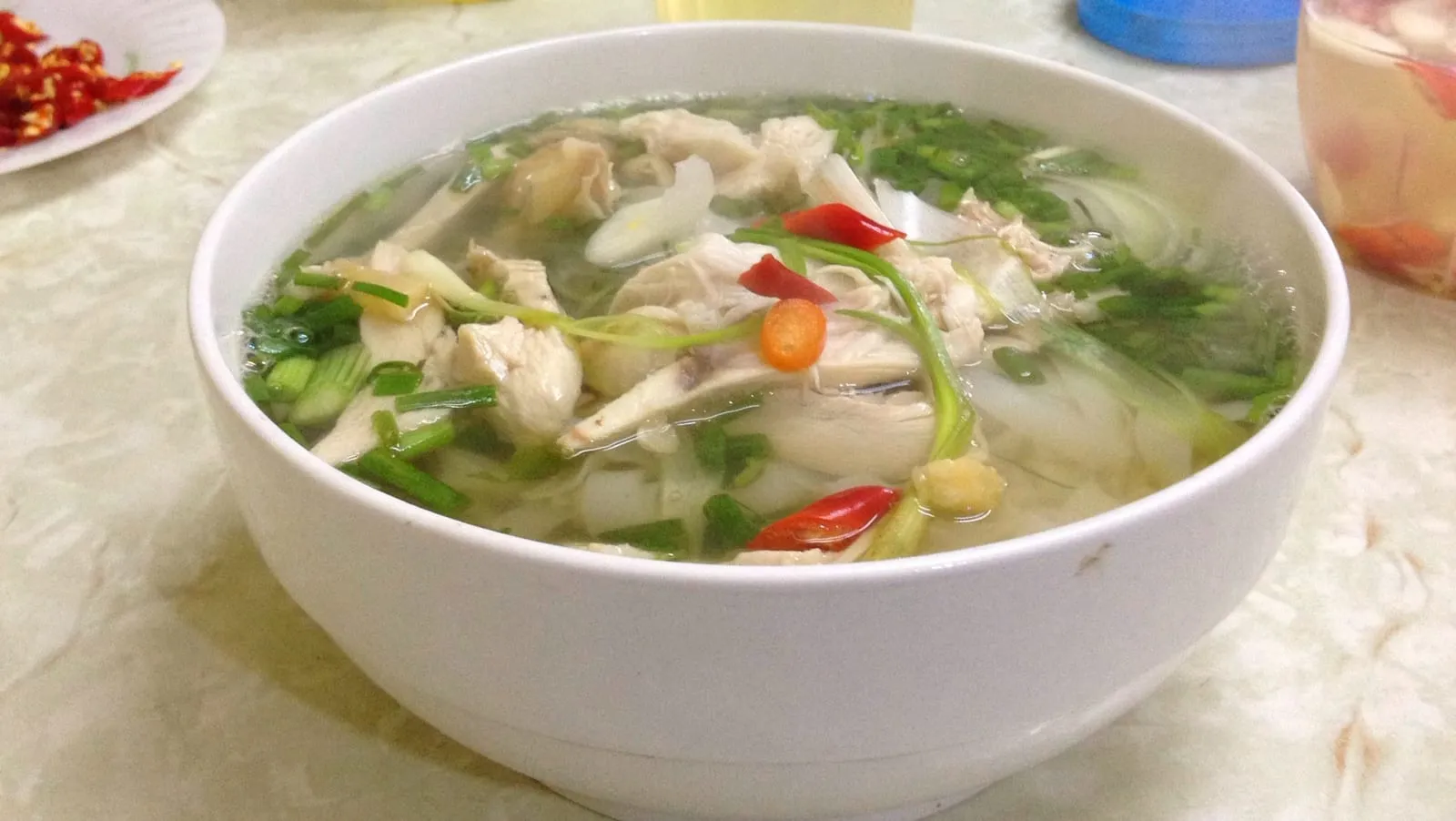
Phở is, despite its now-iconic status as the symbol of Vietnamese cuisine, a relatively recent dish. The earliest documented references date from the early twentieth century, in northern Vietnam — Hanoi and the surrounding Red River delta. The dish does not appear in older Vietnamese cookbooks or food references.
The current most credible historical account is that phở emerged in the early twentieth century in the Red River delta, drawing on three converging influences:
- The Chinese tradition of beef noodle soup (niúròu miàn), particularly the Cantonese variant, which contributed the basic structure of meat-broth-and-noodles.
- The French taste for beef and beef broth, which created a market for beef in a culture that had previously preferred pork and chicken (cattle were primarily draft animals in pre-colonial Vietnam, and the meat was not a routine part of the diet).
- Local Vietnamese herbal-and-aromatic conventions, which contributed star anise, cinnamon, cardamom, ginger, and the herb garnishes (Thai basil, sawtooth coriander, rice paddy herb) served alongside.
The name phở may derive from the French pot-au-feu — "pot on the fire," the classic French boiled-beef-and-broth dish — though the etymological evidence is genuinely contested. What is clear is that the dish acquired its current form in the contact zone between French colonial culinary culture and Vietnamese cooking, and that it spread south after 1954 with the migration of nearly a million northern Vietnamese to the south following the Geneva partition.
The two regional styles diverged after partition. Phở Bắc (northern style) is austere — clear broth, plain noodles, beef, scallions, a little fresh ginger, almost no garnish, no sauces at the table. Phở Nam (southern style) is loaded — richer broth, an abundance of fresh herb garnish (basil, sawtooth coriander, mint, lime, sliced chili, bean sprouts), and a sweeter palate. The southern version is the one most Westerners encounter.
Bánh mì: a French baguette in Vietnamese hands
The bánh mì sandwich is, in a literal architectural sense, a French baguette filled with Vietnamese ingredients. The combination would not exist without French colonial introduction of wheat bread to Vietnam in the late nineteenth century — Vietnamese baking and grain culture had previously been entirely rice-based.
The Vietnamese baguette diverged from the French original in ways shaped by local conditions. Wheat flour was scarce and expensive in colonial Vietnam, so Vietnamese bakers blended rice flour into the dough. The resulting bread is crustier and lighter than a French baguette, with a thinner crust and more open crumb. The shape is also typically smaller — about the length of a hand and a half — sized for sandwich use rather than for eating in slices alongside a meal.
The fillings reflect Vietnamese palette and the colonial-era reorganization of the food supply. The classic bánh mì thịt contains:
- Pâté — French country-style liver pâté adapted to Vietnamese tastes, often coarser and more aromatic than the French original.
- Cold-cut style cured pork (chả lụa — Vietnamese pork sausage, related to French jambon in concept), and sometimes additional grilled or barbecued meats.
- Mayonnaise and butter, both colonial-era introductions.
- Fresh cucumber, cilantro, and pickled daikon-and-carrot — the Vietnamese counterweight to the rich animal proteins.
- Sliced fresh chili and a splash of soy sauce or Maggi (the French-imported seasoning that became, paradoxically, a deeply Vietnamese ingredient).
The sandwich emerged in its current form in southern Vietnam in the 1950s, particularly in Saigon. Like phở, it traveled internationally with the post-1975 Vietnamese diaspora and is now sold in Vietnamese-style cafés in major cities across the world.
The Vietnamese coffee economy
Coffee was introduced to Vietnam by the French in the late nineteenth century, initially as a small cash-crop experiment in the central highlands. By the 1930s, French-owned plantations in the Tây Nguyên — the basaltic plateau region around what is now Buôn Ma Thuột — were producing modest quantities of arabica and robusta coffee for export to France.
After 1975, the coffee industry collapsed along with most of the rest of the economy. The plantations were nationalized, replanted, mismanaged, and largely abandoned. By the early 1980s, Vietnamese coffee production was negligible.
The transformation came after Đổi Mới. The state divested most of the plantations to smallholder farmers — typically households granted long-term use rights to a few hectares each. The smallholders planted Coffea canephora (Robusta) on the rich basaltic soils, where it grows aggressively. Robusta is hardier than Arabica, resistant to coffee leaf rust, and tolerates the central highlands climate without the higher elevations Arabica prefers.
Production grew at a rate that astonished international observers. From a 1986 production of perhaps 18,000 tonnes, Vietnam's coffee output rose to 100,000 tonnes by 1990, 600,000 tonnes by 2000, and over 1.7 million tonnes by 2020. The country became the world's largest producer of Robusta coffee — by some margin — and the world's second-largest producer of coffee overall, behind only Brazil.
The downstream effects on the global coffee market were substantial. Vietnamese Robusta production drove down global Robusta prices in the late 1990s and early 2000s, contributing to a coffee-pricing crisis that severely damaged smallholder farmers in other producing countries (especially in Africa and Latin America). The Vietnamese cultivation expansion also drove deforestation in the central highlands, with substantial native forest converted to coffee monoculture. The environmental costs were and are real.
The Vietnamese consumption side is its own story. Vietnamese coffee culture, descended from French café culture but evolved in distinct directions, runs on:
- Cà phê sữa đá — strong dark-roast Robusta brewed slowly through a small individual metal drip filter (phin) over a layer of sweetened condensed milk, then poured over ice. The condensed milk substitutes for fresh milk (which was scarce in colonial Vietnam) and produces a syrupy, intensely sweet coffee that is now globally recognizable as the signature Vietnamese drink.
- Cà phê trứng — egg coffee — a Hanoi specialty in which whipped egg yolks, sugar, and condensed milk are floated on top of strong black coffee, producing a dessert-like drink. The dish is traditionally credited to a single café in Hanoi (Cafe Giảng) which began serving it in 1946 during a wartime milk shortage as a cream substitute.
- Cà phê muối — salt coffee — a more recent regional specialty from Huế in central Vietnam, in which salted cream is floated on hot strong coffee.
- A growing third-wave specialty coffee scene in Hanoi, Ho Chi Minh City, and Da Nang, producing high-quality Arabica and natural-process Robusta competing with international single-origin coffees.
The country has, in other words, become both a major commodity coffee producer for the global market and a domestic coffee culture distinct enough that its drinks are recognizable as Vietnamese on a café menu in Berlin or Brooklyn.
What the food reveals about the country
The Vietnamese culinary palimpsest is a clear material record of the country's recent history. The wars are not in the food. The colonial period is everywhere in the food. The deep pre-colonial Vietnamese tradition is also everywhere in the food, often less visibly, in the techniques (steaming, grilling on coals, raw-vegetable accompaniment), the staples (rice, fish sauce, fresh herbs), and the regional variations that map onto the geographic essay (essay 1) of this pillar.
What did not survive into the cuisine — the Soviet-aligned planned-economy decade — is itself revealing. Vietnamese food culture is intensely commercial, social, and street-based. Most meals in cities are eaten at small specialized eateries (a place that sells only bún chả, another that sells only bánh xèo, another only cơm tấm). The post-1975 attempt to suppress private commerce, including private restaurants and street food, did substantial damage to this culture in the late 1970s and early 1980s. Its rapid recovery after 1986 — the explosion of small private eateries on every block, the return of street food at scale, the dense morning xôi and bánh cuốn breakfast economy — is one of the most visible markers of the Đổi Mới transformation.
You can read the politics in the kitchen.
What stayed with me
That the most international Vietnamese dish, phở, is approximately as old as the airplane. That the Vietnamese baguette, which seems quintessentially traditional, is the residue of a French colonial wheat-flour shortage that local bakers solved by adding rice flour. That a country with no significant pre-colonial coffee tradition became the world's largest Robusta producer in two and a half decades after a market reform. The Vietnamese genius — culinary and otherwise — is for absorbing what comes in, refusing to let it remain foreign, and turning it into something that no longer feels imported.