In 1858 a French naval expedition, partly motivated by the recent execution of French missionaries by the Nguyễn court, attacked the central Vietnamese port of Đà Nẵng. The attack itself stalled, but it was the beginning of a French project that, by 1887, had assembled the entire territory of modern Vietnam, Laos, and Cambodia into a single colonial federation called l'Indochine française. The French stayed until 1954.
Eighty-six years. Two thirds of the time the United States has existed as an independent country. What the French built, dismantled, and left behind in those eighty-six years shapes Vietnam to this day in ways that are easy to miss because they are now thoroughly Vietnamese.
What the French wanted
French colonial expansion in Asia in the nineteenth century was driven by several converging interests. Trade — France wanted access to the China market, and southern Vietnam offered a useful staging ground. Strategic competition with Britain — Britain had India, France wanted a comparable holding. Catholic missionary activity — France had centuries of Catholic missionary engagement in Vietnam, and the protection of Catholics was a recurring stated motive. And economic extraction — agricultural products, mineral resources, and a labor force the French could organize into plantation production.
The conquest happened in stages. Cochinchina (the Mekong delta and Saigon) was taken first, formally annexed by treaty in 1862 and 1867 as a directly administered French colony. Cambodia was made a French protectorate in 1863. Tonkin (the north, around Hanoi) and Annam (the central coast, with the Nguyễn imperial capital at Huế) were brought under French protectorate status in 1883-84 after the Tonkin Campaign and the Sino-French War. Laos followed in 1893. The Indochinese Union was formally constituted in 1887.
The administrative structure was deliberately uneven. Cochinchina was a colony; Annam and Tonkin (the rest of Vietnam) and Cambodia and Laos were protectorates. The Nguyễn emperors continued to reign, ceremonially, at Huế, and the Cambodian and Lao monarchies continued to exist, but in all cases the French résident was the actual authority. The fiction of indigenous sovereignty was preserved where convenient and abandoned where it was not.
The economic project
The French built an extractive colonial economy. The largest exports by value were:
- Rice, especially from the Mekong delta, where the French expanded paddy land enormously by digging an extensive canal network. By the 1930s Cochinchina was one of the world's largest rice exporters, with most of the surplus shipped to France, Hong Kong, and the Philippines.
- Rubber, planted by French companies on plantations in the southern highlands and northern Mekong delta region. Hévéa brasiliensis, the Amazon rubber tree, was introduced in the 1890s, and by the 1930s Indochina was a major global rubber producer. The plantations were notorious for harsh labor conditions; French companies recruited workers from the densely populated north on long-term contracts that frequently amounted to indentured servitude.
- Coal, from mines in the Quảng Ninh region of northern Tonkin, exported through the port of Hải Phòng.
- Coffee in the central highlands — small acreage at the time, but the seed of what would become an enormous post-1986 industry.
- Opium, sold under a French government monopoly. The opium Régie — a colonial state-run trade in legal opium for sale to colonial subjects — was, at its peak in the 1920s, generating roughly 40% of total Indochinese government revenue. The system was deeply uncomfortable for French observers at the time and was eventually wound down in the 1940s, but for most of the colonial period the colonial state was financed in significant part by drug sales to the population it governed.
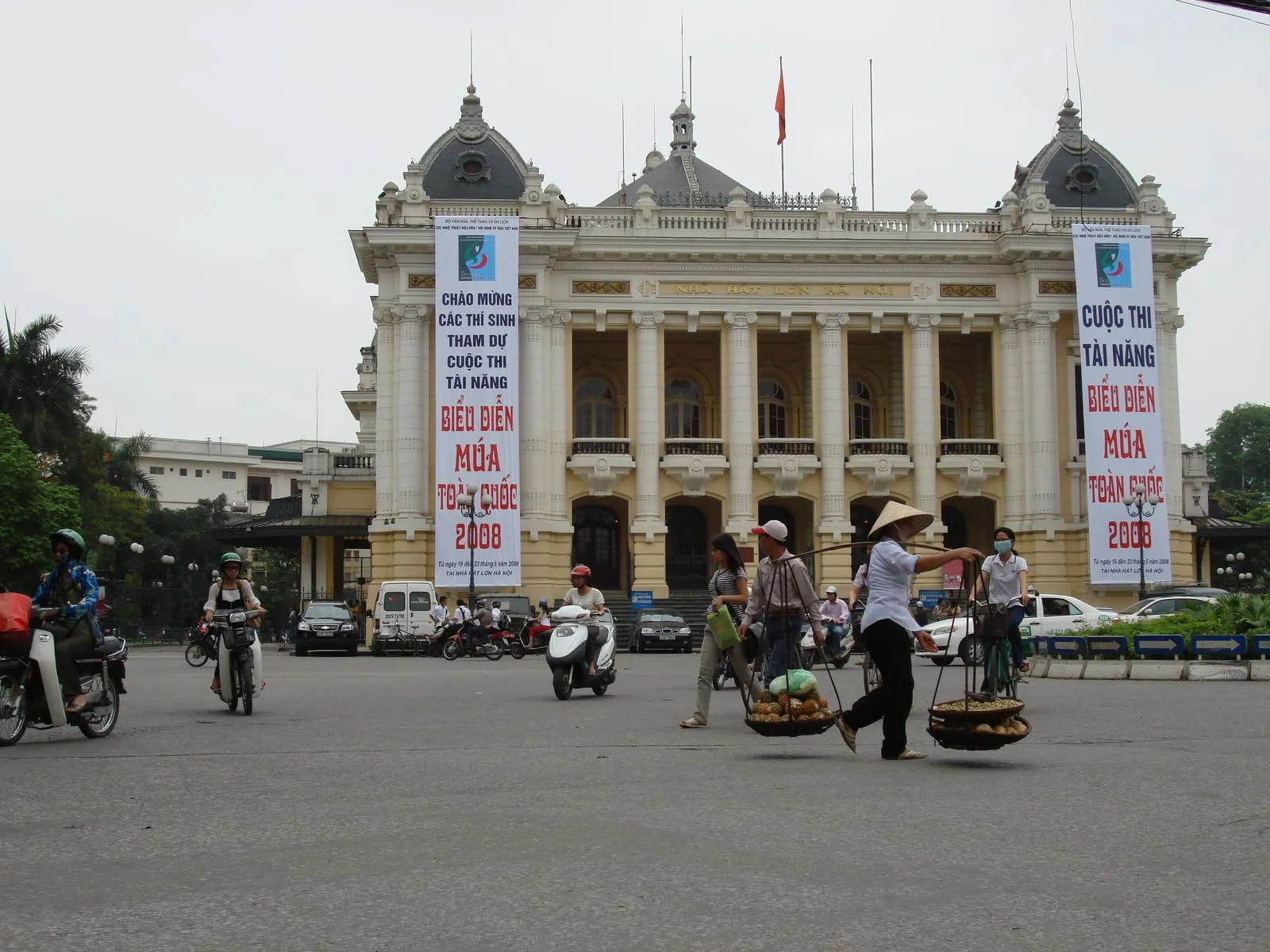
The French also built infrastructure that has lasted. The Trans-Indochinese Railway, running from Hanoi to Saigon along the central coast, was completed in 1936 — it remains the spine of Vietnam's national rail network today. The Hanoi opera house, the Saigon central post office (designed by Gustave Eiffel's firm), the cathedral of Notre-Dame de Saigon, the Long Biên bridge across the Red River — these are still functioning landmarks. The colonial-era boulevards of Hanoi and Saigon define the urban character of both cities.
The cultural and educational project
Two French interventions changed Vietnamese culture in ways the French did not anticipate.
The first was the romanization of the Vietnamese script. Before the French, written Vietnamese had two scripts: classical Chinese for formal and literary use, and chữ Nôm — a system of adapted Chinese characters that recorded Vietnamese phonology — for vernacular literary works. Both required years of study. Catholic missionaries beginning in the seventeenth century, most prominently the Jesuit Alexandre de Rhodes, had developed a Latin-alphabet phonetic transcription system, quốc ngữ ("national language script"), originally for use by missionaries learning Vietnamese.
The French colonial state, looking for a writing system that could be taught quickly to a colonial subject population, mandated quốc ngữ in administration and schools. By the early twentieth century, Vietnamese intellectuals — including many who were anti-colonial — had embraced quốc ngữ enthusiastically. It was vastly easier to learn than the Chinese-character systems, allowed mass literacy as a feasible goal, and produced a new Vietnamese-language popular press, fiction, and political pamphleteering. The first major modern Vietnamese newspapers, novels, and poetry collections in quốc ngữ date from the 1910s and 1920s.
The script reform succeeded so completely that by the 1945 declaration of independence, quốc ngữ was the unquestioned standard. It is the script Vietnamese is written in today. Whatever else French colonial policy did, this single intervention — adopted, paradoxically, because it was easy for the colonial state to administer — gave the Vietnamese language a writing system far more accessible than its predecessors and made Vietnamese-language mass literacy possible.
The second was the colonial education system itself. The French built a network of primary and (for a much smaller fraction of the population) secondary schools across Indochina, with curriculum modeled on French schools, taught in French at the upper levels. The system was small in scale relative to the population — by the 1930s only a small percentage of Vietnamese children received schooling beyond the primary level — but it produced a generation of Vietnamese intellectuals fluent in French, exposed to European Enlightenment political thought, and increasingly aware that the principles France claimed to embody (liberty, equality, fraternity, the rights of man) were not being applied to its colonial subjects.
That generation included Hồ Chí Minh (born 1890, in colonial Vietnam, schooled briefly in the French system, traveled to France and worked as a hotel apprentice), Phạm Văn Đồng, Võ Nguyên Giáp, Trường Chinh, Lê Duẩn — the men who would lead the Vietnamese revolution. The French had, in effect, educated their own opposition.
The resistance
Vietnamese anti-colonial activity was continuous from the earliest French conquests. The first major organized movement was the Cần Vương ("Aid the King") movement of 1885-1896, a Confucian-monarchist resistance that was eventually suppressed. The early twentieth century saw a generational shift toward modern political organizing, partly under the influence of Japan (whose 1905 victory over Russia was electrifying for Asian intellectuals) and partly through Vietnamese students and exiles who had encountered French and Chinese radical movements abroad.
The Indochinese Communist Party was founded in Hong Kong in 1930 by Hồ Chí Minh and others. It was one of several anti-colonial organizations active through the 1930s, but it was the most disciplined and the most successful at organizing both urban intellectuals and rural peasants. By the time of the Japanese occupation of Indochina during the Second World War (1940-1945), the ICP-led Việt Minh — formally the League for the Independence of Vietnam — was the dominant resistance organization in the country.
When Japan surrendered in August 1945, there was a brief power vacuum. Hồ Chí Minh declared Vietnamese independence on September 2, 1945, in Hanoi, opening his speech with an explicit quotation from the American Declaration of Independence. The French, with British and American assistance, returned to attempt to reassert colonial control over the country.
The First Indochina War (1946-1954), fought between French forces and the Việt Minh, ended with the French defeat at the battle of Điện Biên Phủ in May 1954 — a Vietnamese siege victory over a French fortified valley garrison that decisively demonstrated that the French could not hold Vietnam by force. The Geneva Accords of July 1954 ended French rule in Indochina.
What the French left
After 1954, the French departed Vietnam politically, but the colonial inheritance is still visible.
- The quốc ngữ writing system. Universal among Vietnamese speakers.
- The colonial-era infrastructure: the rail line, the bridges, the boulevards.
- French-derived loanwords in everyday Vietnamese: xà phòng (savon, soap), cà phê (café, coffee), bơ (beurre, butter), ga (gare, train station), xích lô (cyclo).
- The food: bánh mì (the Vietnamese sandwich on French baguette), Vietnamese coffee culture (descended from French coffee plantations), pâté and charcuterie traditions adapted into Vietnamese cuisine. We will return to all of this in essay 6.
- A particular bureaucratic style and an educational system that retained French structural features for decades after independence.
- The political idea, embedded in the constitutions of every successor state, that Vietnam is one nation — a claim that French colonial unification of north, center, and south actually helped create the modern conditions for, even as it intended the opposite.
What stayed with me
That French colonial rule simultaneously plundered, modernized, mass-literated, drug-traded, transit-engineered, and university-trained the Vietnamese — and that the people who would eventually drive the French out had been substantially formed by the institutions the French built. Colonial systems are never as one-directional as they appear from either inside or outside. The French built the railroad. They also built the people who would use the railroad to move the soldiers who would defeat them.