The standard Western narrative of Vietnam begins with the French in 1858 and ends with the American withdrawal in 1975. About 117 years. The country itself has a recorded political history — by Chinese sources first, then by its own — going back at least 2,200 years before the French arrived, and an archaeological record going back several thousand more.
The arc has three big shapes. A long period under Chinese rule. A long period of independent Vietnamese dynasties. And, woven through both, the gradual southward expansion of Vietnamese settlement at the expense of the kingdoms that had occupied the central and southern part of the modern country.
The mythological prelude
Vietnamese tradition traces the founding of the first Vietnamese state to the legendary Hồng Bàng dynasty, conventionally dated 2879 BCE — a date that almost no historian takes literally and that most treat as an emblem rather than an event. The mythological founder is Lạc Long Quân, a dragon prince who marries a fairy mountain spirit, Âu Cơ; she bears a sack of one hundred eggs, fifty children go with the father to the sea and fifty to the mountains with the mother, and the eldest founds the kingdom of Văn Lang.
What this mythology does — like most foundation myths — is establish two things. First, that the Vietnamese are autochthonous to the land, descended from spirits of its sea and its mountains. Second, that they were a kingdom before the Chinese arrived, not a tributary or a province. Both claims are politically load-bearing in every later period.
What the archaeological record shows is the Đông Sơn culture, flourishing in the Red River delta from roughly 1000 BCE to 100 CE, producing characteristic large bronze drums (the trống đồng) decorated with ceremonial scenes — boats, dancers, hunters, geometric patterns — that have been found across mainland Southeast Asia and become a symbol of pre-Chinese Vietnamese identity. The Đông Sơn culture practiced wet-rice agriculture, river-mouth trade, and complex bronze metallurgy. It was an organized, materially sophisticated culture, distinct from contemporaneous Chinese cultures to the north.
The thousand years of Chinese rule
In 111 BCE the Han dynasty conquered the Red River delta and incorporated it as the southernmost province of the Han empire — the Jiaozhi commandery. The Chinese remained the political authorities in northern Vietnam, with brief interruptions, for almost exactly one thousand years, until the Battle of Bạch Đằng River in 938 CE.
The Chinese millennium was decisive in shaping Vietnamese culture in some ways and conspicuously failed to absorb it in others. Mandarin Chinese was the language of administration, classical Chinese the literary language, Confucian texts the basis of education, the Chinese calendar the official calendar, the Chinese examination system (when introduced) the path to office. The Vietnamese state, when independent, used these institutions for centuries — most state documents until the early twentieth century are in classical Chinese, not Vietnamese.
But the Vietnamese language continued to be spoken, the Vietnamese village structure continued to function under Vietnamese leadership, the Vietnamese kept distinct customs around marriage, agriculture, ancestor veneration, and household practice, and the population identified culturally as Vietnamese, not Chinese. The result, by the time of independence, was something like Confucian East Asian form with a substantively non-Chinese substance — a pattern visible in much of premodern Vietnamese culture and worth holding in mind because it recurs.
There were periodic rebellions against Chinese rule. The most famous, the Trưng Sisters' revolt of 40 CE, briefly expelled the Chinese from the Red River delta before being suppressed. Subsequent revolts were similarly localized and short-lived. The pattern across the millennium was Chinese provincial control with Vietnamese resentment continuously simmering underneath.
The long independence
In 938 CE, Ngô Quyền defeated the southern Han fleet at the mouth of the Bạch Đằng River, ending Chinese rule. He used a tactic that became a Vietnamese signature: he had iron-tipped wooden stakes driven into the riverbed at low tide, lured the Chinese fleet upriver at high tide, and then, when the tide fell and the stakes pierced the Chinese hulls, attacked.
For the next nine hundred years — from 938 to 1858 — Vietnam was an independent kingdom, with intermittent Chinese invasions repulsed (most famously by the Trần dynasty against the Mongols in 1258, 1285, and 1287, and by the Lê dynasty against the Ming in 1428).
The major dynasties of the independence period:
- Lý (1009-1225): consolidation of the Red River delta as a unified Vietnamese state, founding of Thăng Long (modern Hanoi), construction of the literature temple, beginning of the southern expansion.
- Trần (1225-1400): repulsed three Mongol invasions, expanded southward, developed chữ Nôm — a writing system that adapted Chinese characters to record spoken Vietnamese, used in literary works for several centuries.
- Hồ (1400-1407): brief reformist dynasty crushed by a Ming Chinese invasion that briefly reannexed Vietnam.
- Lê (1428-1788, with interruptions): expelled the Ming, conquered the Cham kingdom of Vijaya in 1471 (a turning point in the southward expansion), eventually fragmented into northern (Trịnh) and southern (Nguyễn) zones with the Lê emperor as a powerless figurehead in Hanoi.
- Tây Sơn (1778-1802): peasant rebellion that briefly unified the country, repulsed a Qing Chinese invasion in 1789.
- Nguyễn (1802-1945): final dynasty, unified the country from Hanoi to the Mekong delta, moved the capital to Huế, formally adopted the name Việt Nam in 1804 (a name with deep roots that became the official state designation under this dynasty).
Through all of this — and this is the second large arc that runs alongside the dynastic story — Vietnamese settlement and political control extended slowly south.
The Nam Tiến — the southward march
For roughly seven hundred years, from the eleventh century to the eighteenth, the Vietnamese expanded southward at the expense of the kingdoms that had occupied the central and southern parts of the modern country. This process is called the Nam Tiến, the "march to the south."
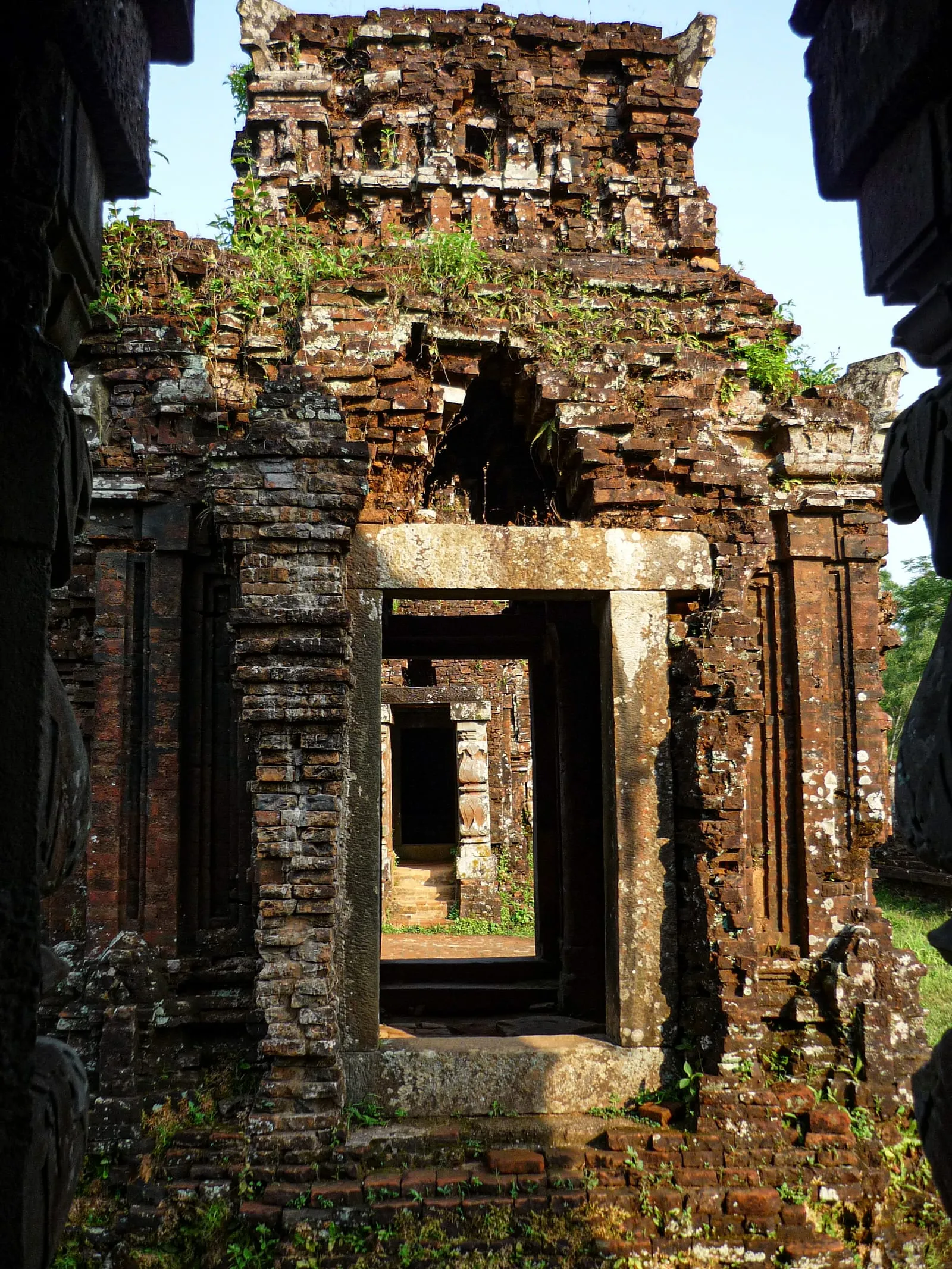
The southward expansion happened in three layered moves. The first was the absorption of the Cham kingdoms — a network of Hindu (later partly Muslim) Austronesian-speaking polities that had occupied the central coast since around the second century CE. Champa was a major regional power, with elaborate temple complexes (the most famous, Mỹ Sơn, near Hội An, is now a UNESCO site whose ruins survive in fragments after centuries of war and weather), a sophisticated maritime trade network reaching to India and Java, and a culture that was almost entirely distinct from Vietnamese. The decisive blow fell in 1471 when the Lê emperor Lê Thánh Tông captured the Cham capital Vijaya and absorbed most of the kingdom; rump Cham polities survived in fragments until the seventeenth century. There are still Cham communities in central and southern Vietnam today — perhaps 160,000 people — preserving language and elements of religion, but Champa as a state was extinguished.
The second move was the absorption of the Mekong delta, which had been part of the Khmer (Cambodian) kingdom of Funan and its successors. Vietnamese migration into the delta accelerated in the seventeenth and eighteenth centuries, and by the early nineteenth century the Nguyễn dynasty had brought the entire delta under Vietnamese political control, with substantial ethnic Khmer populations remaining (and remaining, today — Khmer Krom Cambodians are still a recognized minority in southern Vietnam).
The third move, ongoing through both, was the gradual incorporation of the highland minorities of the Trường Sơn into the Vietnamese state's tributary system, never fully assimilating them but progressively binding them administratively to lowland Vietnamese rule.
The result by the early nineteenth century is something close to the modern Vietnamese state's geographic shape — a long thin country running from the Red River delta to the Mekong delta, with the central coast and the highlands within a single political frame.
What was left when the French arrived
In 1858, when French naval vessels first attacked Đà Nẵng, the country they encountered was a unified Confucian-Buddhist monarchy with a thousand years of recorded independent history, a Chinese-derived literary tradition, a regional language family of its own (Vietnamese is unrelated to Chinese — it is an Austroasiatic language related to Khmer), an established southward-expansion narrative that had run to its geographic conclusion, and a population of perhaps eight million people most of whom lived in two delta agricultural zones.
The French project of the next eighty years was, in part, to convince themselves and the Vietnamese that this was a primitive country in need of European tutelage. The substantial historical record made the project difficult, and the failure of the project — among many other failures — is part of why the colonial period ended the way it did. We will turn to that next.
What stayed with me
That a country whose name in English is now nearly synonymous with two American wars in the 1960s and 1970s has, on its own clock, a continuous recorded history about an order of magnitude longer than the United States' independent existence, and that the Vietnamese sense of national identity — the long memory of a thousand years of Chinese rule, of the Trần dynasty's Mongol-fighting, of the Tây Sơn unification — is older, stronger, and more institutionally embedded than almost any framing the wars produced. The wars were a chapter. The country is a book.