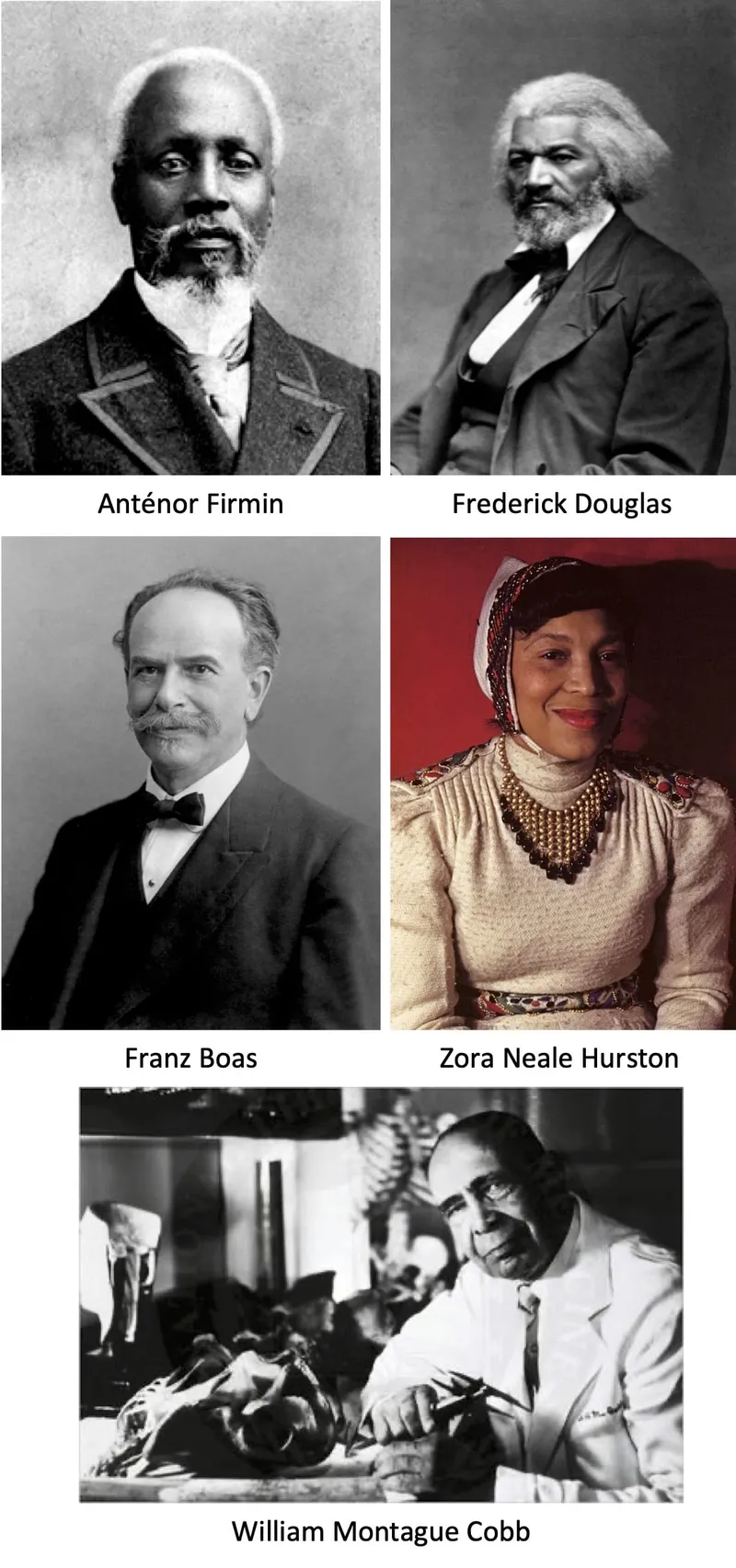
In most of the world, "anthropology" means what the British call social anthropology: the ethnographic study of human societies. In the United States, the word covers four fields that nowhere else are housed in the same department — biological anthropology (skeletons, primates, evolution), archaeology (deep human past through material remains), linguistics (the structure of human language), and cultural/ethnographic anthropology (the lives of contemporary peoples).
The arrangement is American, peculiar, contested, and surprisingly durable.
Why it took this shape
The framing came from Boas at Columbia in the first decade of the twentieth century, and from his contemporaries at the Smithsonian's Bureau of American Ethnology and at Harvard's Peabody Museum. Boas's argument was empirical and political at once. To make any defensible claim about Indigenous American societies — and the discipline he was building was, in its first generation, almost entirely about Indigenous American societies — you needed evidence on every available surface. You needed the language (linguistics), the bodies and biological histories (physical anthropology), the deep past in stone and pottery (archaeology), and the present life of the people (ethnography). No one of these on its own could ground the claims that the dominant evolutionary anthropology was making, and no one of them on its own could refute them.
The political dimension was that Boas wanted to build a discipline that could not be subsumed by any of its components. If anthropology were just the biology of human variation, it would be vulnerable to the racial-typology project that dominated the late nineteenth century. If it were just archaeology, it would be folded into classics or museum work. The four-fields umbrella was, in part, a defensive structure — a way of insisting that human variation could not be understood through any one disciplinary lens, and therefore could not be politically captured by any one ideology.
What each field actually does
Biological anthropology is the field most likely to be misunderstood from outside. It is not the modern descendant of the racial-typology tradition; that tradition was, slowly and explicitly, dismantled by Boas's generation and discarded by the post-war consensus. Modern biological anthropology studies human evolution (paleoanthropology, on the timescale of millions of years), primate behavior (with an eye toward what is and is not specifically human), human population genetics (which now usually shows that within-group variation exceeds between-group variation on almost any measured dimension), and the biology of growth, nutrition, and disease in living populations.
Archaeology in the American tradition has always been anthropological archaeology — the study of past human societies as a way of understanding human society in general, not as a humanistic discipline focused on art-historical objects. American archaeology overwhelmingly studies the Indigenous Americas, and it shares much of its political and ethical complexity with cultural anthropology: contested ownership of remains, repatriation under NAGPRA, descendant communities with their own historical claims.
Linguistic anthropology treats language not as an abstract formal system but as a social practice. Where formal linguistics asks how language can mean anything at all, linguistic anthropology asks what kinds of social work specific languages do — how naming systems index kinship structures, how speech registers track power, how language change correlates with migration and contact.
Cultural anthropology is the largest field and the one most visible from outside. It is the descendant of the Boas-Mead-Benedict tradition: long-term fieldwork, ethnographic monographs, theoretical generalization grounded in particular cases.
What the model has cost
The four-fields umbrella has come under sustained pressure since roughly the 1980s, and the pressure has only grown. Methodological divergence is the obvious problem: a paleoanthropologist running mass spectrometry on early-hominin fossils and an ethnographer doing reflexive fieldwork in Mumbai have, in any given year, almost nothing to read of each other's work that is intelligible to the other. The journals are different. The conferences are different. The graduate training is different. Department meetings, in the words of one chair, are mostly people staring blankly at slides about other people's work.
Some major American departments have split. Stanford reorganized in the 1990s, with biological anthropology going to the medical school. Duke and Harvard have effectively functioned as multiple subdisciplines under a shared name. The American Anthropological Association added section after section, and the membership has become institutionally specialized in ways the formal structure does not reflect.
What the model still buys
In every generation since Boas, however, a defense has surfaced: that the questions anthropology was founded to answer cannot be answered from inside any one of the four fields. The question of what is and is not specifically human cannot be answered without primates and fossils. The question of how cultures change over time cannot be answered without archaeology. The question of what language is socially cannot be answered without ethnography. The four-field structure does not exist because the four fields cohere methodologically. It exists because the questions cohere, even when the methods do not.
What stayed with me, reading through the post-war American ethnographies, is how often the answers a cultural anthropologist gives turn on a fact that came from another field — a date from archaeology, a kinship-term reconstruction from historical linguistics, a growth-curve study from biological anthropology. The fields did not need to share a method to share an argument. That sharing is what is harder to reproduce when the institutional umbrella goes away.