The word "anthropology" predates the discipline by about two thousand years. Aristotle uses it once, casually, to mean a kind of person who talks too much about themselves. The discipline as we know it — with its journals, professorships, and field methods — is roughly a century and a half old, and the people who founded it were, almost without exception, employed in the maintenance of empire.
That fact is not a critique. It is the starting condition. Everything anthropology has done since 1860 is, in one way or another, a working-out of what to do with that inheritance.
The armchair phase
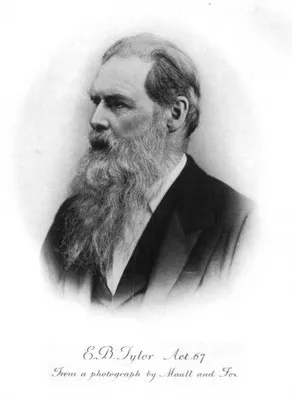
The first generation of self-described anthropologists — E.B. Tylor in Britain, Lewis Henry Morgan in the United States, Adolf Bastian in Germany — never did fieldwork in the modern sense. They read missionary reports, traveler's accounts, colonial administrative records, and built grand schematic theories of how human societies had progressed from savagery through barbarism to civilization. Tylor's Primitive Culture (1871) is the founding monograph in English; Morgan's Ancient Society (1877) is its American counterpart.
Both men assumed that contemporary non-European peoples were "living fossils" — windows onto what European societies had been like in their own deep past. The unilineal evolutionary scheme that resulted (savagery → barbarism → civilization, with European industrial society at the top) is now embarrassing in roughly the way phlogiston is embarrassing. But the scheme was useful to the colonial administrations that paid for it: if subject peoples were simply at an earlier developmental stage, then colonial rule was pedagogy rather than violence.
The Boasian rupture
The decisive break came not from internal critique but from an immigrant outsider. Franz Boas, a German-Jewish physicist by training, fell into anthropology on a year-long expedition to Baffin Island in 1883–84, where he had gone to study the optical properties of seawater and ended up living with Inuit hunters. The experience permanently dissolved his confidence that "civilization" was a single ladder.
Boas spent the next forty years, mostly at Columbia, dismantling the evolutionary scheme. His method was almost prosecutorial: he attacked it on cranial measurement (showing that supposedly fixed racial skull shapes shifted within one generation of immigration), on language (showing that grammatical complexity bore no relation to "civilizational level"), on material culture (showing that supposedly primitive societies had elaborate, locally specific reasoning behind their practices). His students — Margaret Mead, Ruth Benedict, Edward Sapir, Zora Neale Hurston, Alfred Kroeber — became the first generation of professional American anthropologists, and the position they all shared, in the broadest sense, is what came to be called cultural relativism: the idea that any society's institutions can only be understood from inside that society's terms.
The British turn to function
Britain had a different problem. The colonial administrations were larger, the field sites were better-controlled, and the demand was for actionable knowledge: who governs whom, what are the marriage rules, how does land tenure work. Bronisław Malinowski's two-year stay in the Trobriand Islands during the First World War — he was technically an enemy alien interned by the Australian authorities, who allowed him to do fieldwork in lieu of jail — produced Argonauts of the Western Pacific (1922) and a method that became canonical: live there, learn the language, and observe the system as a working whole.
A.R. Radcliffe-Brown, working in the same generation, gave the method a theoretical frame called structural-functionalism. Every institution in a society, the argument went, can be analyzed by what function it serves in maintaining the social whole. Marriage rules, totemic clans, witchcraft accusations — each is a load-bearing piece of an interlocking machine. The framework dominated British social anthropology from the 1920s through the 1960s and produced an extraordinary body of detailed ethnography (Evans-Pritchard on the Nuer, Fortes on the Tallensi, Leach on the Kachin) before collapsing under its own teleological weight: explaining everything as functional made it impossible to explain change, conflict, or failure.
What the discipline became
By the 1970s, anthropology in both traditions had begun to interrogate itself. The colonial entanglement was named explicitly (Talal Asad's Anthropology and the Colonial Encounter, 1973). The objectivity of fieldwork was challenged (Clifford and Marcus, Writing Culture, 1986). The unequal political relationship between ethnographer and subject became part of what every dissertation had to address. The discipline turned, in part, on itself.
What anthropology has, after all of that, that no other social science does is a hundred and forty years of cumulative case studies of how human life is variously organized. Not a theory. The theories rise and fall on a fifteen-year cycle. What persists is the archive: the Trobriand kula ring, the Nuer cattle-feud system, the Balinese cockfight, the Marshall Islands stick charts, the Tukano longhouse cosmology. Anyone who wants to make a claim about human nature now has to pass through that archive, and the discipline's quiet, accumulated answer is that the variation is wider than almost any individual culture's intuitions allow.
What surprised me
That the field's defining method — long-term immersive fieldwork in a language not your own — was invented essentially by accident, by a man stuck on an island during a war he could not get home from. And that the discipline's most durable contribution may not be any of its theories but the example of taking other people's reasoning seriously enough to spend two years learning it before saying anything.