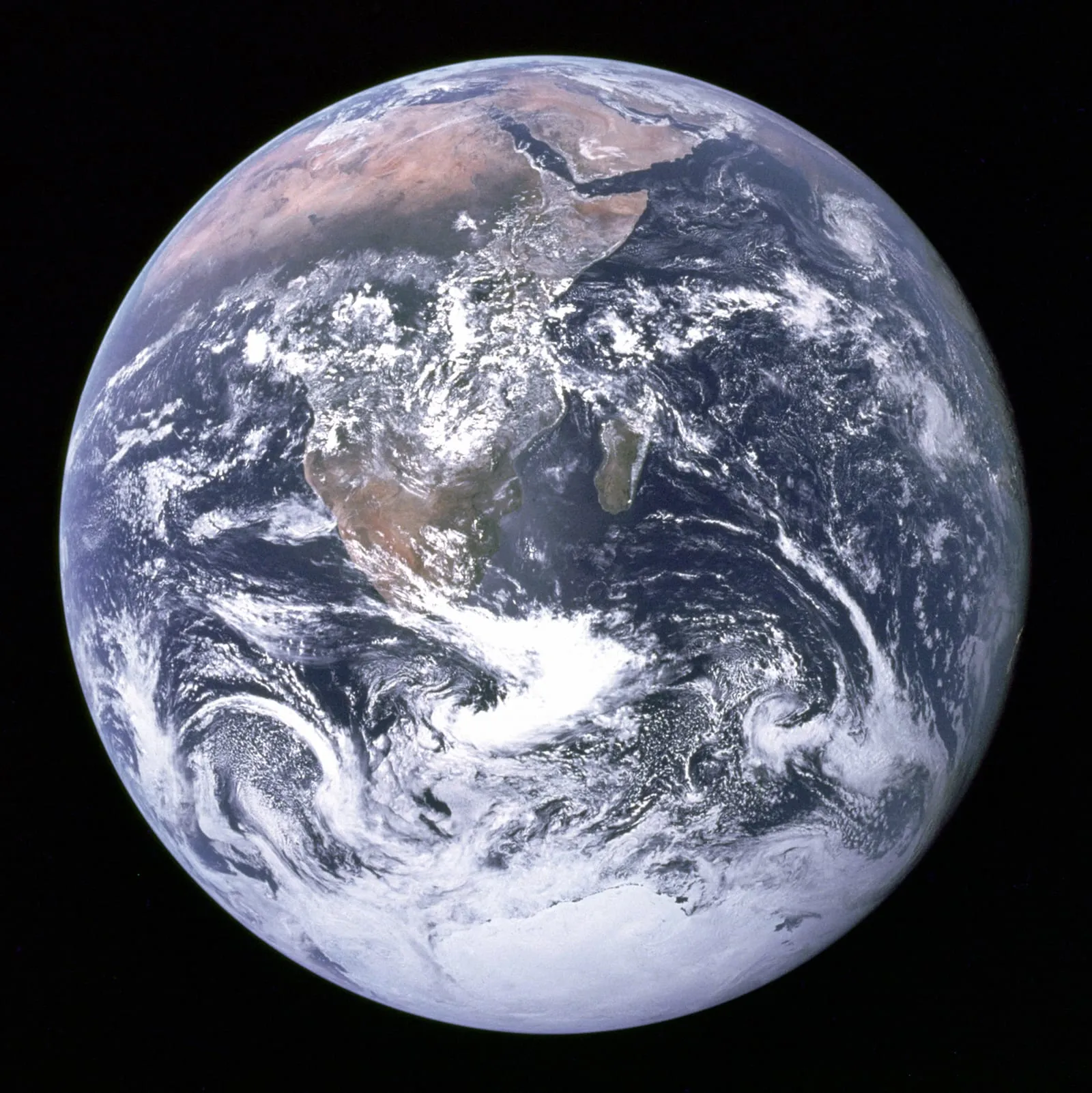
On December 7, 1972, at approximately 5:39 AM Eastern Standard Time, roughly five hours after launch from Cape Canaveral, an Apollo 17 astronaut — the crew has never definitively settled which of them, though Harrison Schmitt's claim is best supported — pointed a Hasselblad 500EL camera with an 80mm lens out the porthole of the spacecraft. The Earth, fully illuminated because the spacecraft was approximately between the sun and the planet, occupied most of the frame. The shutter clicked.
The frame, AS17-148-22727, became known as The Blue Marble. It is the first photograph in human history of the entire fully illuminated Earth taken by a human being.
What had to be true for the photograph to exist
For the Blue Marble to be possible, an unusual combination of conditions had to align.
A spacecraft had to be far enough from Earth that the entire disk would fit in a normal lens. Apollo 17 was, at the moment of the photograph, about 29,000 km out — comparable to the radius of a geostationary orbit, but heading away. Earlier Apollo missions had taken photographs of Earth from approximately the same distance, but most had captured only the partially illuminated planet, with terminator (the day-night dividing line) cutting through the frame.
The geometry of December 7, 1972, was specific. The Apollo 17 trajectory, the position of the sun, and the orientation of the Earth combined so that the spacecraft was directly between the sun and the planet, viewing the fully illuminated southern hemisphere with Antarctica clearly visible at the bottom of the frame. The spacecraft was rotating slowly — the so-called barbecue roll used for thermal management — and the porthole at any given moment offered a narrow, briefly aligned view.
The astronaut had a Hasselblad 500EL pre-loaded with 70mm Ektachrome film, a standard mission setup. The camera was not modified for the photograph; it was the same body, with the same lens, that had been used for several rolls of routine cabin and exterior photography.
What the photograph showed
The Blue Marble is, on the merits, an extraordinary photograph. The full disk of the Earth fills approximately three-quarters of the frame against a black background. The Antarctic ice sheet is fully visible. The cloud systems are sharply defined. Africa fills the upper portion of the disk; Madagascar, the Arabian peninsula, the Indian Ocean are clearly resolved. The blue is much bluer than most representations of Earth in atlases or on globes. The land is browner. The clouds are whiter and structurally more complex than any cartoon globe suggests.
Significantly, the orientation of the photograph as taken by the astronaut had Antarctica at the top and Africa at the bottom — because the astronaut and the spacecraft were oriented in such a way that this was the natural framing. NASA's image distribution office rotated the image 180 degrees before public release, on the assumption that audiences trained on north-up maps would otherwise misread it. The original orientation is rarely seen.
What it changed
The Blue Marble was released into a world that had been reading newspapers about the environmental crisis. Silent Spring had been published in 1962. The first Earth Day was 1970. The OPEC oil shock would arrive in 1973. The United Nations Conference on the Human Environment had just been held in Stockholm in June 1972. The argument that human industrial activity was a threat to a planetary system was already in public circulation; what had been missing was an image that gave the argument a concrete object.
The photograph filled that absence. The Blue Marble became, almost immediately, the visual shorthand for the environmental movement. It appeared on the inaugural cover of Whole Earth Catalog (which had previously used a less complete earlier image). It appeared on every major news magazine of the early 1970s. It became the standard image used by environmental organizations to invoke the planet itself as their object of concern. In a survey of the most reproduced photographs in human history, the Blue Marble usually places in the top five.
The photograph's effect on the popular imagination is more often described in atmospheric than in measured terms — the overview effect, the experience reported by astronauts of seeing Earth from space and being permanently changed by the perception of its smallness, fragility, and singleness. The Blue Marble made that experience available, in a translated form, to people who would never travel to space. The effect was not the same. But the photograph did, demonstrably, alter what it was possible to think about the planet without effort.
What it does not show
The photograph also obscures things, and it is worth being explicit about them. The Blue Marble shows one moment, one hemisphere, in one season, in one set of weather conditions. The Pacific, which is most of the planet's surface, does not appear in the frame. The high northern latitudes, where most human industry is concentrated, do not appear. The image is so thoroughly not partial in its visual rhetoric — it announces itself as a portrait of the entire Earth — that the partiality is hard to remember.
The photograph is also a product of an immensely expensive military-industrial program operating on a Cold War political logic. The Apollo missions were funded primarily as a technological-political contest with the Soviet Union; the imagery they produced, including the Blue Marble, was a side benefit. The fact that the photograph subsequently became the defining icon of the global environmental movement, which was politically uncomfortable for the funders of the Apollo program, is a small irony in cultural history.
The successor images
No comparable photograph was taken between Apollo 17 and the Earth Polychromatic Imaging Camera (EPIC) on the DSCOVR satellite, which since 2015 has produced near-daily full-disk images of Earth from the L1 Lagrange point about 1.5 million km from the planet. The EPIC images are scientifically more useful — daily, multispectral, calibrated — and visually less iconic. The Blue Marble retains its primacy partly because it was first, and partly because the human-taken image carries cultural weight that an automated satellite image does not.
What stayed with me
That a photograph taken almost in passing — by an astronaut between checklist items, on a roll of film primarily allocated to documenting the spacecraft — became, within a decade, the most reproduced image of the planet in human history. The shutter click was casual. The framing was lucky. The cultural absorption was total. Some photographs do not need to be deliberate to become inevitable.