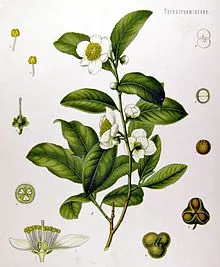
Black tea, green tea, white tea, oolong, pu-erh — the entire global beverage, its trillion-dollar agriculture, its empires and tariffs and ceremonies — comes from a single plant species: Camellia sinensis, an evergreen broadleaf shrub that wants to be a tree.
Differences between green and black tea are not differences of plant. They are differences of processing. The same leaf, picked the same morning from the same bush, can become any of them.
The two varieties
Within the species, two varieties matter for tea. Camellia sinensis var. sinensis — the small-leaved Chinese variety — is the older domesticate. It is hardy, tolerates cold and high elevation, and produces leaves with the delicacy and aromatic range that Chinese, Japanese, and Taiwanese tea traditions are built around. It is the source of nearly all green and oolong teas, of most white teas, and of the more delicate Chinese black teas.
Camellia sinensis var. assamica — the large-leaved Indian variety — was identified as a distinct variety in Assam in 1823 by the Bruce brothers, although it had been used by local communities for at least centuries before that. The leaves are larger, the bushes grow into proper trees if not pruned, and the resulting tea is robust, tannic, and well suited to the harsh black teas that the British market wanted. Most Indian, Sri Lankan, Kenyan, and Ugandan tea production uses assamica or assamica hybrids.
The two varieties cross easily and have been hybridized continuously for two centuries. Most large-scale modern tea agriculture uses cultivars that draw from both gene pools.
The origin question
Where did tea-drinking begin, and from what wild population?
The traditional Chinese answer credits the Emperor Shennong, in roughly 2737 BCE, who is said to have discovered tea when leaves blew into water he was boiling. This is mythology, but the larger Chinese claim — that tea drinking originated in southwestern China — is now well-supported. Camellia sinensis var. sinensis has its highest genetic diversity in Yunnan, which is the signature of a long-established native population. Wild tea trees, some hundreds of years old, still grow in Yunnan; some are venerated and tapped for tea.
The complication is that Camellia sinensis var. assamica may have been independently used for tea in Yunnan and northern Burma at a comparable date, and the two variety lineages probably hybridized very early in domestication. A 2021 Nature Communications study using whole-genome sequencing of cultivated tea plants across China and India argued for biparental ancestry in modern tea — that is, the cultivated tea plant has, over millennia, drawn genetic material from both the small-leaved Chinese and large-leaved Assam wild populations. There is no clean origin point.
What is clear is that by the Tang dynasty (618–907 CE), tea was a commercial commodity in China, with the first known tea monograph (Lu Yu's Cha Jing, c. 760 CE) describing cultivation, processing, brewing, and connoisseurship. By the Song dynasty (960–1279), tea was a state revenue source important enough to be the subject of administrative monopolies and tax disputes.
What the chemistry does
A tea leaf is a remarkable object chemically. It contains:
- Caffeine — at concentrations of 2–5% by dry weight, comparable to or higher than coffee. The caffeine functions as a natural pesticide; the bush produces more of it under herbivore stress.
- L-theanine — an amino acid found in significant concentration almost nowhere else in nature. L-theanine has the unusual property of being psychoactive in a way that combines with caffeine to produce the alert-but-calm effect that distinguishes tea from coffee. The reason a coffee jitter is different from a tea jitter is largely L-theanine.
- Polyphenols (mostly catechins, especially EGCG) — the source of tea's astringency, color development during processing, and most of its claimed health effects. A green tea is roughly 30% catechins by dry weight; a black tea has had most of those catechins enzymatically transformed into theaflavins and thearubigins during oxidation.
- Volatile aromatics — several hundred compounds. The aromatic profile is what processing manipulates.
What domestication has done
The bush wants to be a tree. Left to itself, Camellia sinensis will grow ten to fifteen meters tall and live for centuries; some Yunnan wild trees are documented at over a thousand years. Tea agriculture keeps the plant pruned to about a meter, in a flat-topped hedge that can be plucked from above. The pruning forces the plant into continuous vegetative growth, so it produces tender new shoots — flushes — repeatedly through the growing season.
The first flush of spring is, in nearly every tea tradition, the most highly valued tea of the year. The leaves have spent the winter accumulating sugars and amino acids; the new shoots are at their most aromatic and least bitter. Late-season flushes are coarser and tend to go into commodity blends.
What surprised me
That tea has, almost certainly, been one species the entire time the trade has existed — and that the dramatic differences between, say, a Japanese gyokuro and a Yorkshire builders' brew are differences not of botany but of how a leaf was treated in the four to twenty-four hours after it was picked. The plant is the constant. Everything else is process.