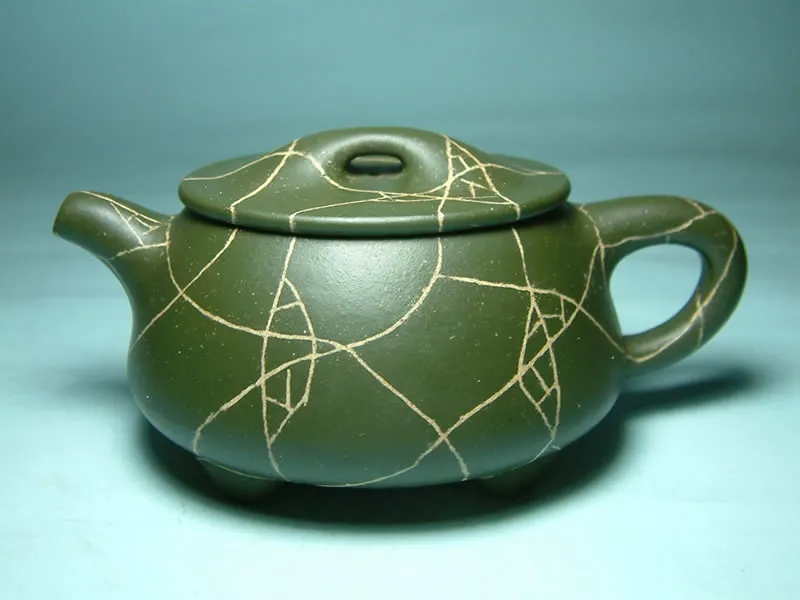
Yixing — pronounced roughly Eee-shing — is a township on the western shore of Lake Tai, about three hours west of Shanghai. The clay that comes out of one specific hill there has been used to make teapots since the Ming dynasty, and the modern tea-drinking world has not found a substitute.
The mineral story
The clay is a rare zisha — "purple sand" — a mix of kaolin, quartz, and mica with an unusually high iron content (8–10%). It fires dense but not vitrified: under a microscope, an unglazed Yixing pot is full of micropores. Tea liquor wets those pores at every brew, leaves trace polyphenols behind, and over hundreds of sessions the pot acquires what tea drinkers call cha xi — "tea breath."
That is not a metaphor. A well-used pot, rinsed only with hot water and never with soap, will bead and release water differently than a fresh one, and a brew run with plain water in a long-seasoned pot will smell faintly of tea. The seasoning is not on the pot; it is in it.
Why one tea per pot
The same property that lets a pot hold its tea makes it ruinously bad at switching. Brew oolong in a pot that has lived its life on shou pu'er, and the first three rounds will taste like a confused argument. Serious drinkers commit a pot to one tea family — sometimes one specific cultivar — for its working life. A collector with five teapots is keeping five private libraries open at once.
The fakery problem
Yixing's geological scarcity has made the clay a target for substitution and re-labeling at every price point, including high ones. Real zisha will not glaze the way mass-market "purple clay" does, will weigh more than it looks like it should, and will ring at a particular dull pitch when you tap the lid against the rim. Tea sellers and pot dealers will tell you the only durable defense is to know your source — and the source is one township, one hill, and a community of working potters whose names circulate in the same way wine producers do in Burgundy.