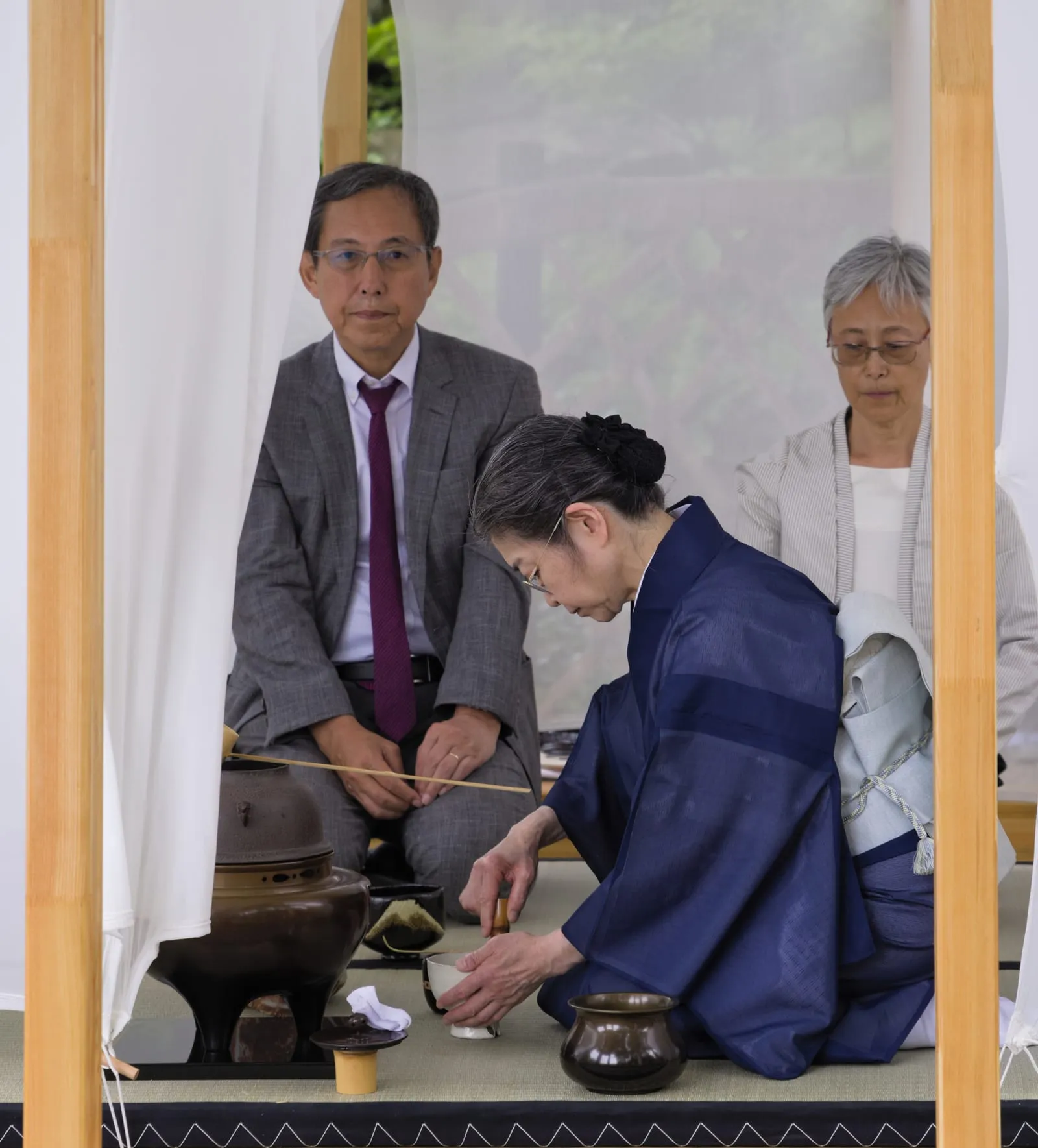
The Japanese tea ceremony — chanoyu, literally "hot water for tea," more grandly chadō, "the way of tea" — is one of the most thoroughly aestheticized social practices in the world. To attend a formal tea gathering is to spend three to four hours in a small room participating in a series of carefully choreographed gestures around the preparation and drinking of two bowls of powdered green tea.
Almost none of the ceremony's depth is in the tea. The tea is the occasion for the ceremony's actual subject, which is attention.
The thing being made
The tea itself is matcha — finely ground green tea powder, made from leaves grown under shade for the last three weeks before harvest. Shading suppresses the production of catechins (which would be astringent) and elevates L-theanine and chlorophyll (which produce the umami sweetness and the deep jade color). The shaded leaves are steamed, dried, and then stone-ground into a powder fine enough to suspend in water without settling.
The tea is prepared in the bowl, not in a teapot: the host adds the powdered tea, ladles in hot water, and whisks the mixture vigorously with a chasen — a bamboo whisk carved from a single piece of bamboo into roughly eighty fine tines. The result is a foam-topped, slightly bitter, vegetal-umami beverage drunk directly from the bowl.
That is the entire technical content of the tea preparation. It takes, in skilled hands, about ninety seconds.
The thing being made around the tea
The ceremony built around those ninety seconds is, in its formal version, an entire afternoon. The guests arrive at the tea garden and wash their hands at a stone basin. They wait in a small outer room. They are admitted to the tea house — a small, low-ceilinged structure entered through a door so small that even a samurai had to remove his sword and stoop to enter, in deliberate imitation of the entries to medieval Christian monastic cells — and seated on tatami. They view the hanging scroll the host has chosen for the occasion, and the flower arrangement, and remark on them.
A light meal — kaiseki, originally derived from Buddhist monastic food — is served, in many small courses presented in lacquered or ceramic vessels chosen for the season. The meal lasts perhaps an hour. The guests withdraw to the garden. The host changes the scroll for a flower arrangement, refreshes the room, and signals the guests to return for the formal preparation of the tea.
The tea is then prepared, served, and discussed. The implements are admired — each is, in a serious gathering, an art object with a name, a history, sometimes a recorded provenance going back centuries. The bowl, the whisk, the tea caddy, the tea scoop, the kettle, the iron brazier, the water jar, the waste-water vessel, the lid rest. The tea scoop alone (chashaku) is a hand-cut bamboo object that the host or one of the host's predecessors typically made; it has its own name; it sits in its own custom-made box.
Why this developed
The form was crystallized in the late sixteenth century by the tea master Sen no Rikyū, under the patronage of Toyotomi Hideyoshi, Japan's effective ruler. Rikyū's contribution was the aesthetic principle of wabi — a deliberate impoverishment of the form. Earlier tea practice in Japan, imported from China, had been ostentatious: imported Chinese ceramics, large gatherings, elaborate ornamentation. Rikyū inverted it. Small rooms, often only two or three tatami mats. Plain Korean and Japanese ceramics, often deliberately asymmetric or imperfect. Wooden vessels, bamboo whisks, raw stone. The aesthetic claim — that genuine refinement consists in choosing the materially humble — was a calculated rejection of the previous century's luxury-driven tea culture and a calculated alignment with the Zen Buddhist sensibility of Rikyū's patrons.
The political context is also unmistakable. Hideyoshi, who had risen from peasant origins to military supremacy, used Rikyū's tea aesthetic as a kind of court culture for the warrior class — a sphere in which a samurai general and a townsman tea master could meet on terms structured by aesthetic refinement rather than by inherited rank. The tea room was, in this sense, designed as a small leveler.
That said, the leveling was conditional. Hideyoshi, having patronized Rikyū for years, eventually ordered him to commit ritual suicide in 1591. The reasons remain disputed — possibly Rikyū had refused to allow his daughter to become Hideyoshi's concubine, possibly he had displeased Hideyoshi by allowing a statue of himself to be placed at a temple gate, possibly the ruler simply felt the tea master had become too influential. Rikyū obeyed the order. Tea aesthetics and political brutality were, in this case, the same court.
The schools
After Rikyū's death, three of his descendants founded what became the major surviving schools of tea — Omotesenke, Urasenke, and Mushakōjisenke, collectively the San-Senke. Each school is a hereditary lineage with its own slight variations of procedure, its own headquarters in Kyoto, and its own active membership. Urasenke is the largest and most internationally visible; its grand master and his branch institutions teach tea in dozens of countries.
The schools are also commercial enterprises and cultural-political institutions, and the formal pedagogy of tea ceremony is enormous — most serious students take years to qualify in the basic procedures and decades to qualify in the more elaborate ones. Tea is a practice in the strong sense: it is something one does for life, advancing through grades, accumulating implements, internalizing the small distinctions of seasonal procedure that distinguish a winter gathering from a high-summer one.
What the practice produces
After three or four hours in a tea room, what one has done, materially, is drink two bowls of green tea and eat a small meal. What one has practiced is a kind of attention to material that is otherwise hard to schedule into a contemporary life. You have looked closely at a piece of pottery for ten minutes. You have noticed the seasonal flower in the alcove. You have followed a sequence of hand movements with no goal other than to follow them. You have shared the room with three or four other people doing the same.
That is, in the end, what the form is for. Tea is the pretext. The occasion to pay this kind of attention is the product. The form has survived for four hundred years because the product remains scarce.
What stayed with me
That a culture invested four centuries of design effort into making it impossible to drink a cup of tea quickly. The contrast with the British tea-bag-in-a-mug — the same plant, the same beverage in chemical terms, prepared in ninety seconds, drunk in two minutes, often during another activity — is not a contrast of refinement versus crudeness. It is a contrast of two cultures making opposite decisions about what tea is for.