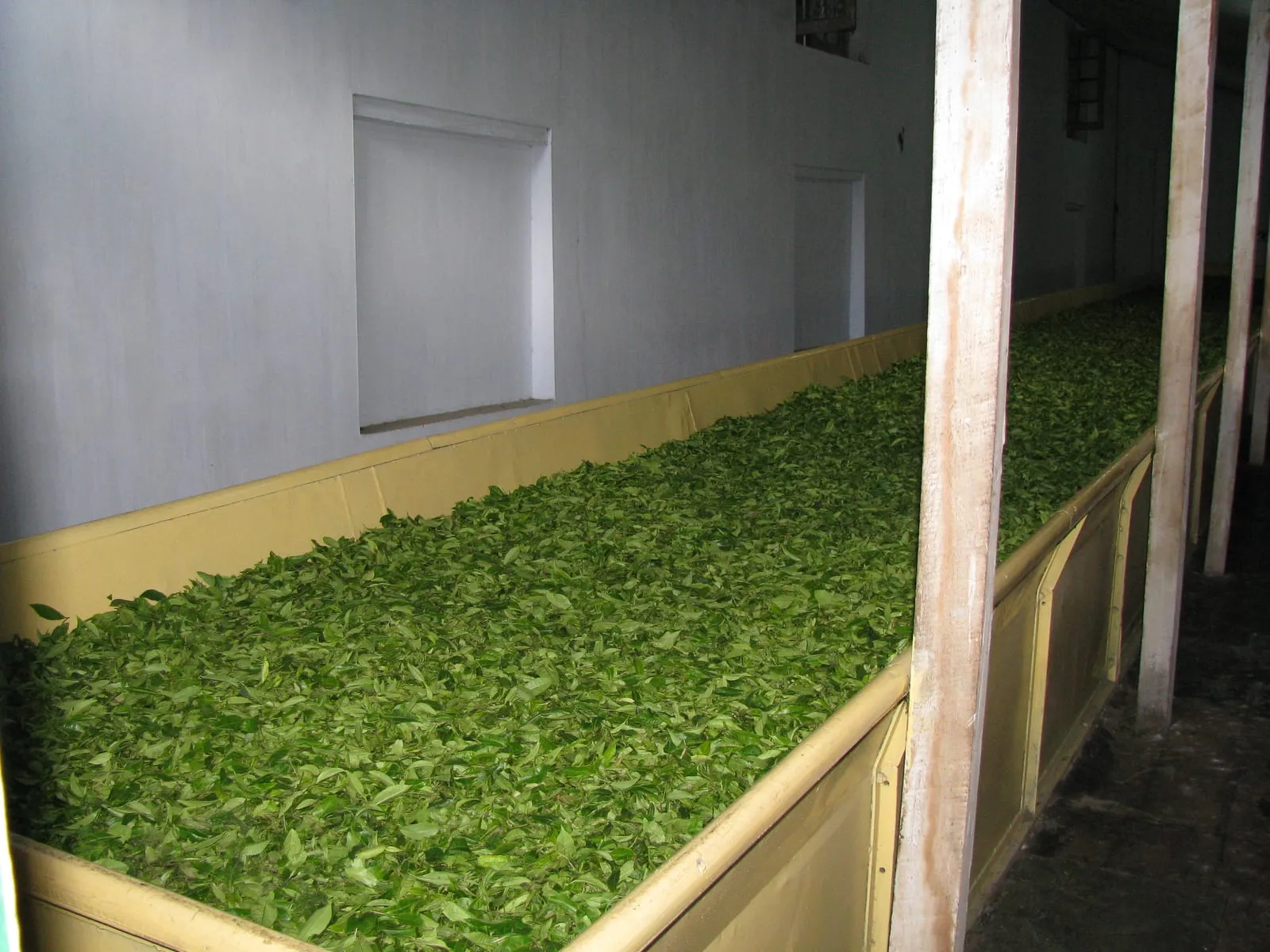
A tea leaf, the moment it is picked, begins to change. Cells rupture. Enzymes meet substrates they were previously kept separate from. Polyphenols begin to oxidize. Aromatics begin to volatilize. The whole subsequent journey of the leaf — into a finished tea — is a series of decisions about which of these processes to allow, encourage, or stop.
The result is an exhibit of how much variation a small set of process variables can produce.
The single hinge: oxidation
The pivotal variable is oxidation — often imprecisely called fermentation in older tea literature. When a tea leaf is bruised, its catechins are exposed to the enzyme polyphenol oxidase, which is normally compartmentalized away from them. The catechins react with oxygen, rapidly turning the leaf darker and converting the relatively bright, astringent catechin compounds into the heavier, mellower, redder theaflavins and thearubigins.
This reaction can be:
- Stopped almost immediately, by the application of heat that denatures the enzyme.
- Allowed to proceed partway, then stopped.
- Encouraged to completion.
The six tea categories sort, primarily, by where on this oxidation gradient the leaf was halted.
Green tea
The leaf is heated within hours of picking — by pan-firing in China or steaming in Japan — to denature the polyphenol oxidase before significant oxidation can occur. The catechins are largely preserved in their original form. The result is a beverage with high astringency, vegetal aromas, and a relatively pale liquor. Within green tea, processing variables that distinguish styles include:
- Kill-green method (steaming vs pan-firing): Japanese steamed green teas (sencha, gyokuro, matcha) have a more vegetal, marine, umami profile; Chinese pan-fired greens (longjing, biluochun) have a roasted, chestnutty edge.
- Shading: Japanese gyokuro and tencha (the precursor to matcha) are grown under shade for the last three weeks before picking, which forces the plant to over-produce chlorophyll and L-theanine. The result is a sweeter, more umami tea with much less of the catechin astringency.
White tea
Minimal processing: the leaves are picked young (often only the bud and the first leaf), allowed to wither in the open air for one to three days, and then dried. There is no kill-green and no rolling. Because the cell walls are mostly unbroken, polyphenol oxidase has limited access to the catechins, and oxidation proceeds only modestly. The resulting tea is delicate, hay-scented, slightly sweet, and lightly oxidized — typically 5–15%.
Yellow tea
A Chinese specialty that essentially treats the leaves as green tea but adds a menhuang (sealed yellowing) step: the warm, slightly damp leaves are wrapped in cloth or paper for hours to days, during which a non-enzymatic mellowing occurs. The result has the structural backbone of green tea with a softer, more rounded character. Yellow tea is a small category and increasingly rare; it is labor-intensive and not significantly more profitable than green tea, and many traditional yellow tea producers have switched to green processing.
Oolong
Partial oxidation, in the 15–80% range. The leaves are typically withered, then bruised — by tossing in baskets, shaking, or rolling — to rupture cell walls along the leaf edges, then allowed to oxidize for hours, with the oxidation halted at a desired point by pan-firing. The result is a tea with both fresh, floral, fruity green-tea characteristics and the heavier, honeyed, mineral characteristics of oxidation. Within oolong, the spectrum is enormous:
- Lightly oxidized (10–25%): Taiwanese high-mountain oolongs, Tieguanyin (modern style). Floral, lactic, almost greener than green.
- Heavily oxidized (60–80%): Wuyi cliff teas (yancha), Dongding traditional. Mineral, roasted, stone-fruit, sometimes called rock-rhyme.
Black tea
Full oxidation. Leaves are withered, rolled to rupture cells thoroughly, oxidized to completion (typically a few hours under controlled humidity), and dried. The catechins are largely converted to theaflavins and thearubigins. The liquor is dark, the astringency is reorganized into a softer briskness, and the flavor profile shifts toward malt, chocolate, dried fruit, and red wine. Most of the world's industrial tea is black tea, processed by the CTC (crush-tear-curl) method which produces uniform pellets ideal for tea bags.
In China, this category is called hong cha — "red tea" — because the liquor is red, not black.
Pu-erh and other dark teas
A category apart: the leaves undergo post-fermentation by microbial action, either slow (sheng / raw pu-erh, aged for years to decades) or rapid (shou / ripe pu-erh, in a controlled wet-piling process developed in 1973). Microbes — bacteria, yeasts, and several molds, especially Aspergillus niger — break down catechins and other compounds and produce a tea with an earthy, woody, sometimes barnyard character. Aged pu-erh from Yunnan is one of the few teas that genuinely improves over decades and that develops a recognizable terroir based on the storage environment as much as the original processing.
What the processing reveals
Every tea is the same plant. The category-defining variables are: how long do you wither, do you bruise the leaves, how warm and how long do you allow oxidation, when do you kill the enzyme, do you allow microbial post-fermentation. That is the entire taxonomy.
The reason this matters, beyond connoisseurship, is that it reveals tea-making as a craft of negative space. The processor's main job is not to add anything — there are no spices, no fermenting agents traditionally, no flavor compounds. The job is to control which of the leaf's intrinsic biochemical reactions are permitted to run, and to what extent. The finished tea is the leaf, plus a sequence of permissions.