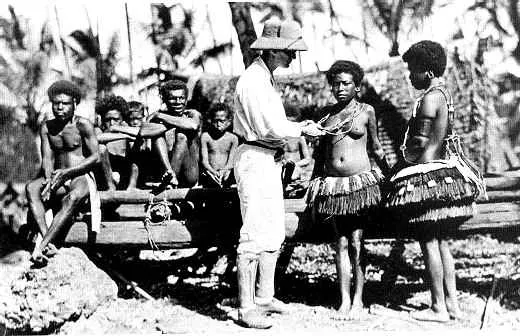
Sit with the people. Speak the language. Stay long enough that what was strange on day one is ordinary by month six. Take notes anyway, because what you have learned to find ordinary is the thing you came to study.
That is the method, in one paragraph. It is also the discipline's defining commitment, the source of its richest material, and the largest single ethical problem it has not solved.
How it became canonical
Before Malinowski, anthropological fieldwork was mostly survey work — the researcher arrived, stayed for weeks, conducted structured interviews through interpreters, and left. Boas's Baffin Island year was a partial exception, but the institutionalization happened in the Trobriands. Malinowski's two-year stay — extended by his internment as an enemy alien during the First World War — produced Argonauts of the Western Pacific (1922), and the introduction of that book is, more than the rest of it, what changed the discipline.
In the introduction, Malinowski lays out a method as a set of imperatives: live in the village, not at the missionary station; learn the vernacular language well enough to dispense with interpreters; observe the rhythms of daily life directly rather than asking informants to describe them; record social rules as a synoptic chart, but pair every rule with the imponderabilia of actual life — the mood, the gossip, the ways the rule gets bent in practice.
The textual move was as important as the methodological one. By writing the introduction as a method-statement rather than a narrative, Malinowski transformed being there from a memoir trope into a credentialing claim. After 1922, "I have been there for two years" became a thing one said in print, and a thing readers learned to expect.
What you actually do
The day-to-day texture of fieldwork is much less heroic than the introduction suggests. You learn names. You learn the social geography of who eats with whom, who lends to whom, who refuses to be in a room with whom. You attend ceremonies you only half understand. You go to gardens, fishing trips, funerals. You write field notes every night, in two registers: the jottings (chronological, sketchy, often nearly unreadable later) and the expanded notes (typed up, indexed, the basis of any future writing). The expanded notes are where the discipline's working memory lives.
You also wait. Most of what you go to study happens irregularly. A circumcision ceremony, a divorce dispute, a presidential election, a funeral feast — the events that organize the social structure are not on a schedule. Twelve months in the field is the conventional minimum because that is the time it takes to see the major ceremonial cycle once. Twenty-four months, the historic standard, is the time it takes to see the cycle twice and notice what varies.
The unresolved problem
Malinowski himself made the problem inescapable, posthumously. His widow published his personal field diaries in 1967, and the diaries showed a man deeply unhappy in the field, racially contemptuous of the Trobrianders he was studying, sexually frustrated, ill, and bored. The contrast between the Argonauts persona — the patient, sympathetic, methodologically rigorous observer — and the diary's actual fieldworker — irritable, lonely, openly racist about specific individuals — landed on the discipline like a depth charge.
What the diary made undeniable is that participant observation is not just a method; it is a narrative voice the method produces. The voice in the published ethnography is composed. It elides the resentment, the failures of comprehension, the moments the ethnographer was excluded from. The case for participant observation is that the close, sustained presence yields knowledge no other method can. The case against it is that the presence also yields a relationship — affective, racialized, asymmetric — that the published text cannot fully account for.
The post-1980s response was reflexivity: write yourself into the text. Acknowledge what you did not understand, who refused to talk to you, what your position in the field made impossible. Reflexivity is now the default. It has not solved the problem so much as made the problem visible on the page.
What the method still does
For all of that, no method has replaced it. Surveys catch one shape of social fact; structured interviews another; computational social science a third. None of them catch the imponderabilia — the things people do not know how to articulate, because they have never had to articulate them, because everyone around them already knows. Participant observation is the only method that systematically goes after the implicit. That is what the discipline still trades on.
What stayed with me
The image of Malinowski writing his diary at night in his tent — calling the people whose kinship system he is patiently mapping by slurs, in his private journal, while in the morning he will sit with them again and ask the next careful question — is, for me, the truest image of the method's promise and its compromise. The work is real. The relationship is also real. Neither cancels the other.