The phrase "Silk Road" is a 19th-century coinage — Ferdinand von Richthofen, 1877 — projected backward over fifteen hundred years of commerce that the people doing the commerce never thought of as a single thing. What was actually happening, between roughly 200 BCE and 1500 CE, was a network of overlapping regional trade circuits: Chinese silk and porcelain moving west through the Tarim Basin, Persian silver and glass moving east, Indian cotton and spices moving in both directions, and the cities along the route taxing every pound of every shipment.
A handful of those cities became, for stretches of a few centuries each, among the richest places on earth.
Samarkand
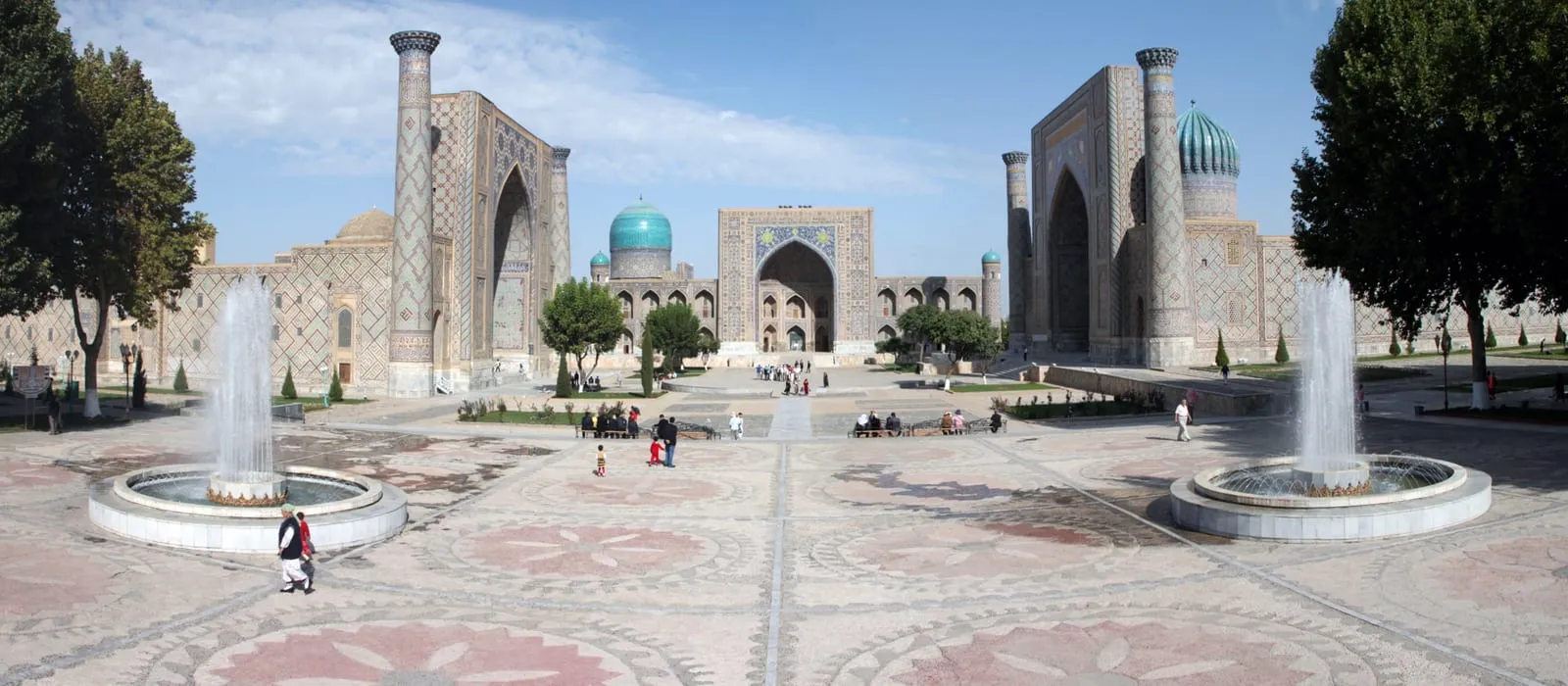
Tamerlane's capital in the late fourteenth century, sacked by the Mongols a hundred and fifty years earlier and rebuilt with conscripted craftsmen from every territory Tamerlane had conquered. The Registan square — three madrasas facing each other across an open plaza, every visible surface tiled in turquoise, lapis, and gold — was the political center of an empire that ran from Anatolia to Delhi. Today the square is restored, the tile work too perfect in places, and you have to walk twenty minutes east to find the unrestored Bibi-Khanym mosque collapsing into itself, which is, weirdly, the more affecting building.
Bukhara
A trading hub before Samarkand was, and quieter now. The old town is dense with caravanserais, small mosques, and the four covered bazaars where money changers, jewelers, hat sellers, and book dealers held adjoining stalls for centuries. The Kalyan minaret — 47 meters of unglazed brick from 1127 — was reportedly so beautiful that Genghis Khan, who razed everything else in the city, ordered it left standing.
Merv
The hardest one. Merv was one of the largest cities in the world for several centuries, possibly the largest, and the Mongols — Tolui, Genghis Khan's son — destroyed it in 1221. The destruction is recorded by Persian chroniclers as a deliberate, multi-day extermination of the population, with the irrigation works dismantled afterward so the land could not be reoccupied. It worked. The city did not return. What is left, near modern Mary in Turkmenistan, is a UNESCO site of low brown walls and a single intact mausoleum standing in two hundred square kilometers of nothing.
What the cities have in common
They were all wealthy because of distance. Their job was to be roughly halfway between two endpoints that wanted to trade with each other, and they extracted a percentage. The route shifted — sea trade through the Indian Ocean cut the legs out from under the overland network in the 1500s — and the cities did not.
Walking through any of them now, you are walking through what happens when the reason a place existed stops existing, slowly, over a generation or two. Some of the buildings get restored for tourists. Some collapse politely. The bones are the same.