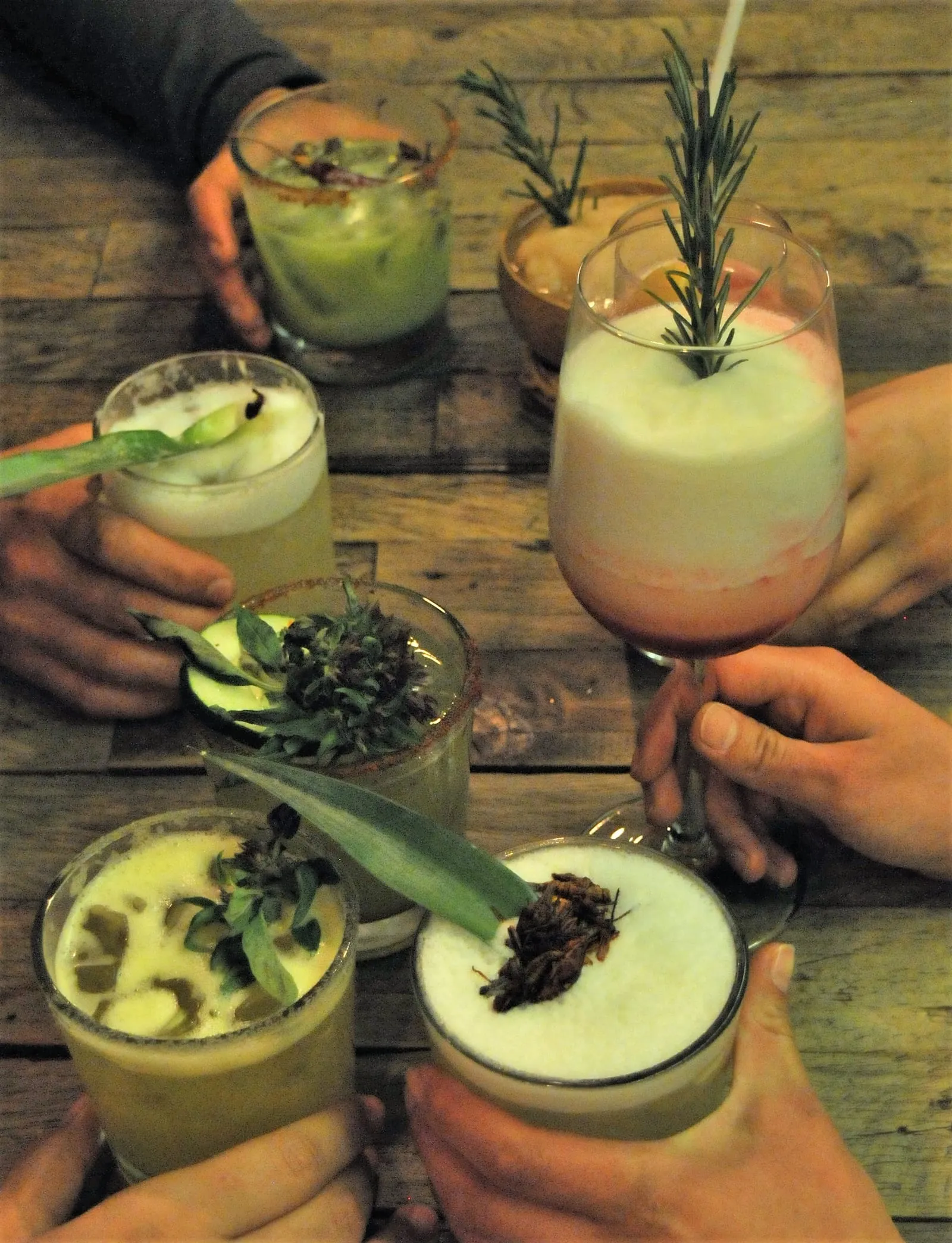
Mezcal is the family; tequila is one of the children. Tequila must be made from blue agave, in a few specific Mexican states, by industrial methods — the agave is steamed in autoclaves and column-distilled. Mezcal can be made from any of fifty-odd agave species, and in the Oaxacan tradition it is roasted in stone-lined pits over wood, crushed under a stone wheel pulled by a mule, fermented in open wooden vats with whatever yeast lives in the air, and twice-distilled in small copper or clay stills.
Everything about that production sequence is slower, smokier, and harder to scale. That is the point.
The agaves
A Espadín plant, the workhorse, takes seven to ten years to mature. Tobalá, the wild upland agave, takes twelve to fifteen. Tepeztate — the rarest of the cultivated rarities — can take twenty-five years to flower, after which the entire plant dies. Every bottle of single-varietal mezcal is, mathematically, the end of a plant that was alive longer than the people who drank it have been adults.
Wild agaves do not regenerate at the rate they are being harvested. The supply problem is structural and worsening, and any drinker paying attention to a label is also reading an extraction curve.
What the smoke is
When the agave hearts are roasted in pit ovens for three to five days under hot stones and earth, two things happen. The plant's complex fructans break down into fermentable sugars (you cannot ferment raw agave; it has almost no free sugar), and the fibers absorb phenolic compounds from the wood. That second part is the smoke. It is not added; it is baked in.
The smoke is also a marker of process. An autoclave does the sugar conversion in twelve hours and produces no smoke. A pit oven does it in seventy-two hours and produces a spirit that tastes like the wood that fed it. The smoke is, in effect, a verification stamp.
The argument
The regulatory framework around mezcal — the Denomination of Origin, the certification body, the categories like artesanal and ancestral — exists in continuous tension with two forces. Industrial producers want to expand what counts as mezcal so they can make it faster. Small palenqueros want to protect what counts so they can keep making it the way their grandfather did, which is also the only way it has ever been made.
What I took home from Oaxaca, more than the spirit itself, was the recognition that "traditional production" is not nostalgia in this context. It is a live political position about the speed at which things are allowed to be made, and who gets to decide.